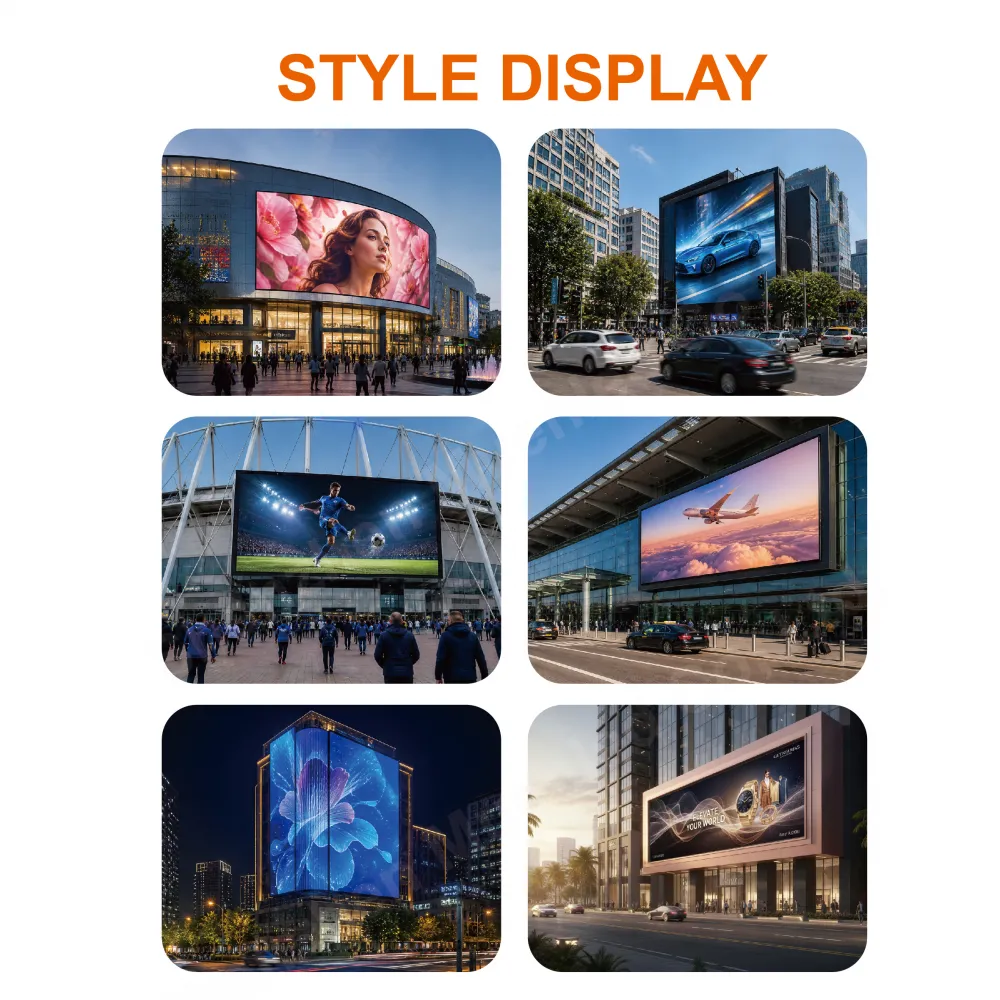
The True Cost Breakdown of Outdoor LED Billboard Screens
When procurement teams compare outdoor LED screens, the conversation eventually becomes a spreadsheet: price per square meter, power per square meter, service cost per year. On that spreadsheet, P10 class products dominate the volume segment — and this article breaks down, in numbers, why the ASE10 outdoor LED advertising screen is the benchmark cabinet in its class.

Cost Driver #1: Pixel Count
An LED screen’s cost is driven first by how many LEDs it must place per square meter. The arithmetic is unforgiving:
| Pitch | LEDs per m² | Relative LED cost |
|---|---|---|
| P3 | ~111,000 | ~12× |
| P6 | ~27,800 | ~3× |
| P10 | 10,000 | 1× |
Going from P6 to P10 removes nearly two-thirds of the diode count. For a 46m² billboard (9.6×4.8m), that difference alone often exceeds the entire steel and installation budget. The ASE10 carries 9,216 pixels per 960×960 cabinet — the economical frontier where image quality still fully satisfies 10-meter-plus viewing.
Cost Driver #2: Brightness Headroom
Cheap P10 screens often spec 4500–5000 nits at best-case settings and age down from there. The ASE10 is rated >5000 nits with headroom, meaning it holds full-sun readability for years, not just at acceptance testing. Brightness headroom is what protects the media revenue of a billboard site over a five-year lease.
Cost Driver #3: The Drive System
The 1/4 scan electronics do double duty: they reduce peak current (smaller power budget, cooler cabinets) and lengthen LED life. Combined with Muen-brand power supplies — a unit type chosen by volume manufacturers for its field reliability — the ASE10’s failure-rate profile is the kind that keeps service contracts profitable.
Cost Driver #4: Serviceability
Rear service is a procurement line item that pays monthly. Compare two billboards: one requiring a lift or frontal scaffold access for every module swap, one serviced from behind by a standing technician. Over a year of typical repairs, the difference in labor and access equipment is measured in thousands of dollars per site.
And because the ASE10 runs the Novastar control system, the industry standard, any qualified technician in any city can service it — no proprietary-lock-in premiums, no waiting on a single vendor’s calendar.
Cost Driver #5: Standardization

One cabinet footprint across every screen in a fleet means: one spare pool, one training program, one content workflow. Operators running three sites or thirty sites compound this saving identically.
The Verdict
For audiences beyond 10 meters — roads, rooftops, venues, industrial gates — the ASE10 sits at the intersection of the lowest LED count, serious brightness, standard electronics, and rear-service economics. That intersection is precisely where the industry’s highest-volume projects are won. Full specifications and configuration options are on the official product page.