Billboard icons: definition, examples, and creation methods
Want to build a billboard icon? Learn the location strategy, LED specs, and content formula behind the world’s most iconic outdoor displays .

Every city has its billboard icon — and Times Square has dozens.
Towering LED screens wrap around every building. Motion, color, and light hit you from every direction. This is one of the few places on earth where out-of-home advertising is not just part of the landscape — it is the landscape. The same is true at Shibuya Crossing in Tokyo, at Piccadilly Circus in London, at Chengdu’s Taikoo Li.
A billboard icon isn’t defined by size alone — it’s a display so commanding it becomes part of the city itself. People photograph it. Brands compete for it. Tourists plan trips around it.
So what separates a forgettable roadside screen from a true billboard icon? In this guide, we break down the definition, the world’s best examples, the technology behind them, and how to build one yourself.
1. What Is a Billboard Icon?
A billboard icon is more than an advertising structure — it’s a cultural landmark.
The term carries two meanings. In everyday language, it describes any outdoor display so recognizable it has become inseparable from its location. In the LED display industry, it refers to a landmark-grade installation: large format, ultra-bright, and powerful enough to shape how people experience a place.
The distinction from a standard billboard is straightforward:
- A standard billboard delivers a message.
- A billboard icon becomes the destination.
True billboard icons don’t just promote brands. They attract tourists, generate organic social media coverage, and earn a permanent place in local culture. They become part of a city’s identity — the kind of landmark that residents feel proud of and visitors specifically seek out.
2. The World’s Most Iconic Billboard LED Displays
Some locations don’t just host billboard icons — they are defined by them. Here are the displays that set the global standard.
2.1 Times Square, New York — The Billboard Capital of the World
One Times Square commands the city’s attention through over 10,000 square feet of state-of-the-art digital signage on the world-famous Times Tower — the heart of New York City and an internationally recognized symbol of media, marketing, and entertainment.
In 2019, the individual billboard screens were replaced by a single 350-foot-tall Samsung LED display, with a resolution of 1,312×7,380 pixels — effectively a 25-story beacon of light visible across midtown Manhattan.
The numbers behind the icon are staggering. Times Square draws an estimated 50 million visitors annually, with approximately 330,000 people passing through daily. Daily advertising rates can reach USD $150,000 — on New Year’s Eve, over one billion people worldwide watch the Times Square celebration across television and livestreams.
What makes it iconic: Unmatched footfall, global media exposure, and a 100-year legacy of being the world’s most competitive advertising real estate.
2.2 Shibuya Crossing, Tokyo — Where Screens Surround You
Shibuya Crossing has been described as the world’s busiest pedestrian crossing, with as many as 3,000 people crossing during a single green light cycle. A 2014 survey recorded about 260,000 people crossing on an average weekday, swelling to 390,000 on weekends.
What makes it a billboard icon isn’t one screen — it’s the full 360° immersion. Giant LED displays wrap the entire intersection from every angle, creating an environment where advertising and urban identity are completely inseparable. The crossing is a popular tourist destination and a widely recognized symbol of Tokyo through its frequent appearances in television, film, and other media.
What makes it iconic: Total visual immersion, world-record foot traffic, and decades of global pop culture appearances.

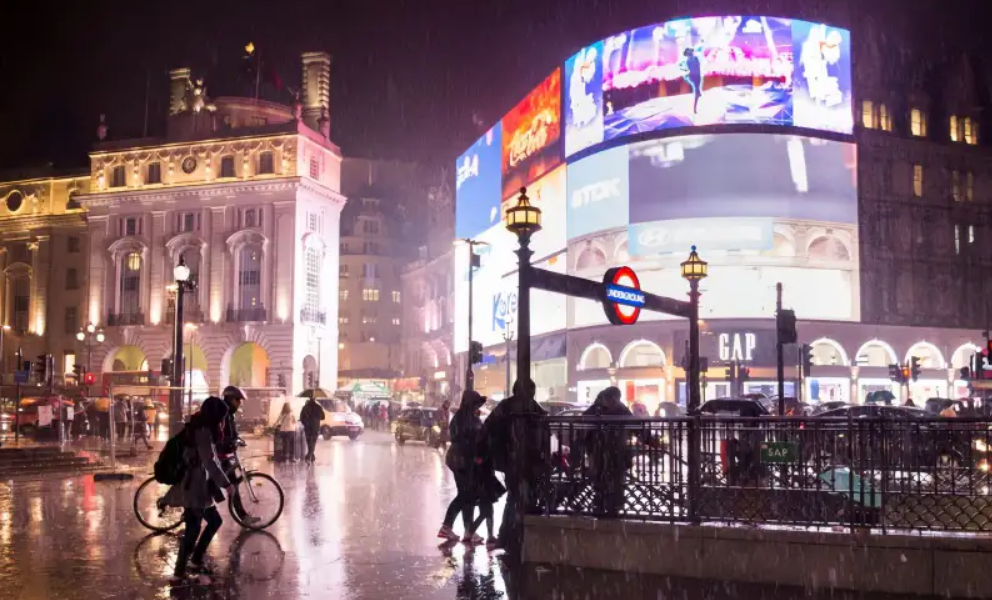
2.3 Piccadilly Circus, London — A Century of Light
For more than 100 years, Piccadilly Circus has been home to one of the most iconic landmarks and lucrative advertising spaces on the planet. In 2017, the site underwent its most significant upgrade yet.
The world-famous Piccadilly Lights were upgraded to a single 783.5m² screen with a resolution 1.4× greater than 4K — making it the largest advertising display in Europe. Built by Daktronics with an 8mm pixel pitch, the display generates trillions of colors and high brightness, while an estimated 100 million people pass through Piccadilly Circus each year.
What makes it iconic: Over a century of brand heritage, Europe’s largest single screen, and a location that is as much a London landmark as Big Ben.

2.4 Shibuya, Tokyo — The Rise of the 3D Billboard Icon
Beyond the crossing itself, Tokyo has pioneered a new chapter in billboard iconography: naked-eye 3D LED displays. The 3D billboard near Shibuya Crossing sits in one of the busiest pedestrian areas in the world, making it a dream location for advertisers — and a global trendsetter for creative content.
Giant cats, pandas, and branded characters appear to leap out of curved LED screens, blurring the line between advertising and street art. These displays don’t just attract attention — they go viral worldwide.
What makes it iconic: Cutting-edge 3D LED technology, extreme creativity, and organic global reach through social media.

The common thread across all of these? Prime location, ultra-high-brightness LED technology, and content bold enough to stop people in their tracks. In the next section, we break down exactly what it takes to build a display at this level.
3. What Makes an Outdoor LED Display Become a Billboard Icon?
Not every large screen becomes a landmark. The ones that do share six common traits.
(1)Prime Location — Being Where Eyes Already Go
Location is non-negotiable. A billboard icon needs to be planted at a convergence point — a busy intersection, a commercial strip entrance, a highway interchange where thousands of vehicles pass daily.
What separates a good location from a great one isn’t just foot traffic. It’s dwell time. The longer people linger — waiting to cross a street, sitting in traffic, walking through a square — the deeper the screen embeds itself into their daily visual experience. Over time, familiarity breeds cultural attachment. The screen stops being an ad and starts being a fixture.
(2)Ultra-High Brightness — Visible Day and Night
Brightness is the single most important technical spec for any outdoor LED display. A screen that washes out in afternoon sun isn’t a landmark — it’s a wasted investment.
Outdoor digital billboards require a brightness of 7,000–10,000 nits, as they are often exposed to direct sunlight — high brightness and excellent color performance attract more attention while ensuring ad content remains clearly visible at different times of day.
For auto-brightness installations, sensors can adjust luminance depending on time of day — with 7,000–10,000 nits recommended for south-facing billboards in equatorial regions under peak sun exposure. At night, the same smart system dims automatically, protecting viewers and extending LED lifespan.
(3)Large Format & Right Pixel Pitch — Scale That Commands Attention
Size creates impact. But scale alone isn’t enough — the pixel pitch has to match the viewing distance, or the image quality breaks down.
For outdoor advertising and large billboards, P8–P10 is the standard recommendation for viewing distances of 15–30 meters, designed for high brightness and long-distance visibility. For premium urban locations where audiences are closer — city plazas, pedestrian streets — P4–P6 delivers a noticeably sharper image, with a practical rule that the minimum comfortable viewing distance in meters roughly equals the pixel pitch in millimeters.
The bottom line: choose the pixel pitch your audience actually needs — not the finest pitch available.
(4)Dynamic Content — Motion Captures the Human Eye
Static images hold attention for seconds. Motion holds it for much longer.
The human eye is hardwired to detect movement. A dynamic LED display — cycling video, animated graphics, or real-time data — consistently outperforms static print in attention metrics. And at the cutting edge, naked-eye 3D content takes this further still: oversized characters and objects appearing to leap from the screen generate social media shares that money cannot buy, extending the display’s reach far beyond its physical location.
Content is what turns a technically impressive screen into a cultural moment.

(5)Weatherproof & Built to Last
Iconic status takes years to earn. A display that fails after one rainy season never gets the chance.
Outdoor billboard icons are built to IP65 rating or higher — fully dustproof and protected against water jets from any direction. They’re engineered to handle extreme temperature swings, high humidity, and UV exposure across a service life measured in decades. The structural integrity of the cabinet, the quality of the LED modules, and the reliability of the power supply all determine whether a screen earns its place in the skyline — or gets quietly replaced.
(6)Smart Content Management — Remote, Real-Time, Always On
A billboard icon that runs the same ad for six months stops being iconic. It becomes wallpaper.
The best installations are powered by a CMS (Content Management System) that allows operators to update content remotely in real time — scheduling different campaigns by time of day, rotating multiple advertisers, pushing live data like weather or news, and responding to events instantly. This keeps the display fresh, maximizes revenue per square meter, and ensures the screen always has something worth watching.
Get all six of these right, and you don’t just have an LED display. You have a billboard icon.
4. Billboard Icon vs Standard Billboard — Key Differences
Most outdoor advertising does its job quietly. A billboard icon does something else entirely — it becomes part of the city.
Here’s exactly where the two diverge:

| Comparison Dimension | Standard Billboard | Billboard Icon (LED Landmark Display) |
| Content Format | Static print or basic digital slides | Dynamic video, animation, real-time data integration, immersive 3D content |
| Brightness Level | 1,500–3,000 nits | 7,000–10,000+ nits for high-visibility urban environments |
| Visibility | Primarily daylight or limited night lighting | 24/7 visibility in all weather conditions |
| Content Updates | Manual replacement — days or weeks required | Remote CMS control — updates within minutes |
| Pixel Pitch | Not applicable (print-based) | P4–P10 optimized according to viewing distance |
| Operational Lifespan | 3–5 years before material degradation | 100,000+ hours of LED operation |
| Revenue Model | Single advertiser, fixed-term contract | Multiple advertisers with rotational scheduling |
| Cultural & Social Impact | Functional advertising medium | Becomes a city landmark; attracts tourism and social media exposure |
| Weather Protection | Basic outdoor resistance | IP65+ rated, engineered for long-term outdoor durability |
The gap isn’t just technical. A standard billboard occupies space. A billboard icon owns it.
Brands that advertise on a standard billboard get impressions. Brands that appear on a billboard icon get association — with a place, a moment, and a cultural identity that outlasts any single campaign.
5. How to Build Your Own Iconic Billboard LED Display
A billboard icon doesn’t happen by accident. It’s the result of five decisions made right from the start.

Step 1: Choose the Right Location
No amount of technology compensates for a bad location. Before anything else, validate your site with hard data:
Daily foot or vehicle traffic — aim for high-volume convergence points.
Dwell time — intersections, plazas, and transit stops outperform fast-moving highways.
Viewing angle and distance — your audience needs a clear, unobstructed sightline.
Zoning and permits — confirm local regulations before committing to a structure.
The best locations feel obvious in hindsight. They’re where people already stop, look, and linger.
Step 2: Determine Screen Size & Pixel Pitch
Size and pixel pitch must work together. A screen that’s too small lacks presence. A pixel pitch that’s too fine wastes budget on resolution no one can see from the street.
| Viewing Distance | Recommended Pixel Pitch |
| 5–10 meters | P4 – P5 |
| 10–20 meters | P6 – P8 |
| 20–50 meters | P8 – P10 |
| 50 meters and above | P10+ |
Match the spec to the real-world viewing distance — not the largest screen your structure can hold.
Step 3: Select the Right LED Technology
Three main technologies dominate outdoor installations today:
- SMD (Surface Mounted Device) — the industry standard for outdoor billboards. Wide viewing angle, proven durability, cost-effective at scale.
- GOB (Glue on Board) — SMD modules coated in protective resin. Superior moisture and impact resistance, ideal for high-humidity or coastal environments.
- COB (Chip on Board) — highest density, best uniformity, strongest protection. Suited for premium urban installations where image quality and longevity are paramount.
For most iconic billboard applications, SMD at IP65+ is the proven baseline. GOB and COB are worth the premium for harsh environments or flagship projects.
Step 4: Plan Your Content Strategy
The screen is the canvas. Content is what makes it iconic.
- Motion over static — dynamic video consistently outperforms still images in attention and recall.
- Daypart scheduling — tailor content to morning commuters, lunchtime crowds, and evening foot traffic.
- 3D and interactive content — naked-eye 3D campaigns generate organic social media reach that extends your display’s audience globally.
- Rotate advertisers — multiple brands on a scheduling loop maximizes revenue and keeps the display fresh.
A billboard icon needs content worth stopping for. Plan this before installation, not after.
Step 5: Work with a Reliable LED Manufacturer
Your manufacturer determines the long-term success of the installation. Evaluate on four criteria:
- Certifications — CE, FCC, UL, RoHS as a minimum for international projects
- Brightness and warranty specs — insist on verified nits ratings and a minimum 3-year on-site warranty
- Customization capability — iconic installations are rarely standard sizes; your manufacturer must handle custom shapes, curved modules, and integration with existing structures
- After-sales support — remote diagnostics, spare parts availability, and local service partners matter more than upfront price
The right manufacturer isn’t just a supplier. They’re a long-term partner in keeping your display performing at landmark level for years to come.
7. Conclusion
A billboard icon is never just a screen. It’s the result of three things aligned: the right location, the right technology, and content bold enough to stop people mid-stride.
Get all three right, and your display stops being an advertising structure. It becomes a landmark — something your city recognizes, your audience remembers, and your competitors can’t replicate.
Whether you’re planning a large-scale digital billboard, a naked-eye 3D installation, or a high-impact LED media facade, the formula is the same: prime location, powerful visuals, and a display built to perform for decades.