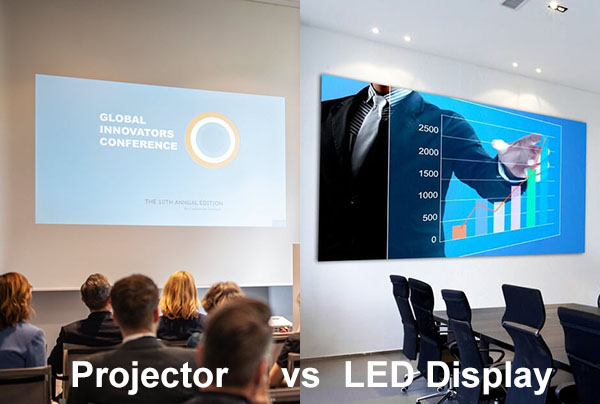
LED Displays vs. Projectors: A Comprehensive Comparison and Selection Guide for Commercial Applications
When planning a large-screen display for a business space, conference room, church, or commercial venue, one question comes up again and again:
Should I choose an LED display or a projector?
At first glance, both can deliver big images. Both are used in meeting rooms, auditoriums, and event spaces. But once you look beyond surface-level specs, the differences become very clear—especially in brightness, image quality, maintenance, and long-term cost.
In this guide, we take a practical, real-world look at LED display vs projector, focusing on commercial and professional use cases rather than home entertainment hype. There is no one-size-fits-all answer, but by the end of this article, you’ll know exactly which solution fits your space, budget, and usage goals.
A Quick Look at LED Display vs Projector
For readers who want a fast overview, the core difference is simple.
Projectors rely on reflected light, which means image quality is highly dependent on room lighting and screen conditions. LED displays are direct-view screens that produce their own light, allowing them to remain clear and vivid in almost any environment.
This fundamental difference affects everything else—from brightness and lifespan to maintenance and operating cost.
What Is an LED Display Wall?
An LED display wall is made up of modular LED panels that emit light directly. Each pixel is a physical light source, which allows the screen to maintain consistent brightness and color accuracy regardless of ambient light.

In commercial environments, this is a major advantage. Whether the screen is installed in a bright conference room, a shopping mall, or a corporate lobby with glass walls, the image remains stable and readable.
Modern LED displays, especially fine pitch LED screens, are designed for close viewing. As pixel pitch becomes smaller, LED walls are no longer limited to large venues. They are now commonly used in meeting rooms, control centers, and high-end presentation spaces.
Because LED displays are modular, screen size is highly flexible. The display can be scaled to fit the wall rather than forcing the room to adapt to the screen.
What Is a Projector System?
A projector creates an image by casting light onto a surface, usually a projection screen or wall. The final image quality depends on several external factors, including ambient light, projection distance, and screen material.

Traditional projectors use lamps, while newer models often use laser light sources. Laser projectors last longer and offer more stable brightness, but they also come with a higher initial cost.
Projectors are popular because they can produce large images with relatively low upfront investment. In dark or controlled environments, they can still deliver very good visual results.
However, because the image is projected rather than directly emitted, performance drops quickly when lighting conditions are less than ideal.
Quick Comparison: LED Display vs Projector (At a Glance)
| Feature | LED Display | Projector |
| Brightness | Very high (800–1,500+ nits indoor) | Limited, affected by ambient light |
| Image clarity | Sharp at large sizes | Degrades as image size increases |
| Ambient light performance | Excellent | Poor to moderate |
| Screen size | Seamless, scalable | Limited by throw distance |
| Lifespan | 50,000–100,000 hours | 5,000–20,000 hours |
| Maintenance | Modular, minimal downtime | Lamp or laser replacement |
| Installation | Permanent, professional | Flexible, easier to move |
| Long-term cost | Lower total cost of ownership | Higher over time |
If you only need a quick answer:
Projectors are cheaper to buy. LED displays are cheaper to own.
LED Display vs Projector: Key Differences Explained
This is where the real differences start to matter.
Brightness and Ambient Light Performance
Brightness is one of the most noticeable differences when comparing an LED display with a projector.
LED displays are typically rated in nits, and indoor commercial models commonly operate between 800 and 1,500 nits or more. This level of brightness allows the screen to remain clearly visible even in well-lit spaces.

Projectors, on the other hand, are measured in ANSI lumens. While high-lumen projectors exist, their real-world performance is still heavily affected by ambient light. In conference rooms with windows or retail spaces that stay bright throughout the day, projected images often appear washed out.
This is one of the main reasons LED displays are increasingly replacing projectors in permanent commercial installations.
Image Clarity and Resolution at Large Sizes
On paper, both LED displays and projectors can offer high resolution, including Full HD and 4K. In practice, image clarity behaves very differently.
As projector image size increases, sharpness depends on precise focus, projection distance, and screen quality. Small misalignments or surface imperfections can reduce clarity, especially for text and detailed graphics.

LED displays maintain consistent clarity because LED display resolution is defined by physical pixels. With a suitable pixel pitch, an LED wall can deliver sharp visuals even at very large sizes. This makes LED screens particularly effective for presentations, data visualization, and detailed content.
When comparing LED wall vs projector for professional presentations, clarity at scale is often a deciding factor.
Screen Size Flexibility and Installation Limits
Projector screen size is limited by room depth, ceiling height, and throw distance. In some spaces, achieving the desired screen size simply isn’t possible without structural compromises.
LED displays do not face these limitations. Because they are built from modular panels, the screen can be designed to fit the available wall space exactly. Unusual aspect ratios, curved designs, and ultra-wide formats are all possible.
For large venues or architectural installations, this flexibility is a major advantage.
Lifespan, Reliability, and Daily Operation
In professional environments, screens are often used for many hours every day. This is where long-term reliability becomes critical.
LED displays typically offer a lifespan of 50,000 to 100,000 hours. Even after years of use, brightness degradation is gradual and predictable.
Projectors have shorter lifespans by comparison. Lamp-based models require regular lamp replacement, while laser projectors last longer but still fall well below the operational life of an LED display.
For businesses that rely on uninterrupted operation, LED displays usually offer greater reliability and less downtime.
Maintenance and Long-Term Cost Considerations
At first glance, projectors appear to be the more economical choice. The initial purchase cost is often lower, especially for large image sizes.
Over time, however, maintenance changes the equation. Lamp replacement, optical servicing, and recalibration all add to ongoing costs. Any maintenance also means screen downtime, which can be disruptive in business environments.
LED displays are modular. If a module fails, it can be replaced without shutting down the entire screen. This makes maintenance faster and more predictable.
When total cost of ownership is considered, many businesses find that LED displays become the more cost-effective solution over the lifespan of the system.
LED Display vs Projector for Different Applications
In conference rooms and corporate spaces, LED displays are increasingly preferred because they perform well in bright environments and deliver consistent image quality throughout the day. Presentations remain clear without the need to dim lights.
In retail and advertising, brightness and visual impact are essential. LED displays clearly outperform projectors in these settings and are now the dominant solution.
In education and training rooms, both technologies are still used. Projectors remain viable where budgets are limited and lighting can be controlled.
Churches and auditoriums often face a direct choice between LED display vs projector. While projectors may seem attractive due to lower upfront cost, many organizations eventually transition to LED walls to reduce maintenance and improve visibility.
For home theater use, the situation is different. In dark, controlled environments, projectors can still offer a cinematic experience that appeals to many users.
Cost Comparison: Short-Term vs Long-Term
The cost difference between LED displays and projectors is often misunderstood.
Projectors are usually cheaper to buy. LED displays require a higher initial investment. But over time, factors such as lifespan, maintenance, energy use, and downtime all contribute to total cost.
This is why many businesses start with projectors and later upgrade to LED displays once operational costs become clear.
The Future: Will LED Displays Replace Projectors?
In commercial and professional environments, the trend is already visible. For businesses that need high brightness, sharp image quality, and long-term reliability, fine pitch indoor LED displays have become a common replacement for traditional projection systems. Fine pitch LED displays are becoming more affordable, easier to install, and more common in spaces that once relied on projection.
Projectors will not disappear, especially in temporary or controlled environments. However, for permanent installations, LED displays are increasingly becoming the default choice.
Final Thoughts
Choosing between an LED display and a projector is not about which technology is newer or more impressive. It is about understanding how each performs in real-world conditions.
For most businesses, conference rooms, and large venues, LED displays offer better brightness, longer lifespan, lower maintenance, and stronger long-term value. Projectors still have their place, but mainly in environments where budget and lighting conditions allow them to perform at their best.
If the goal is a reliable, professional display solution that works every day with minimal compromise, an LED display is often the more practical investment.