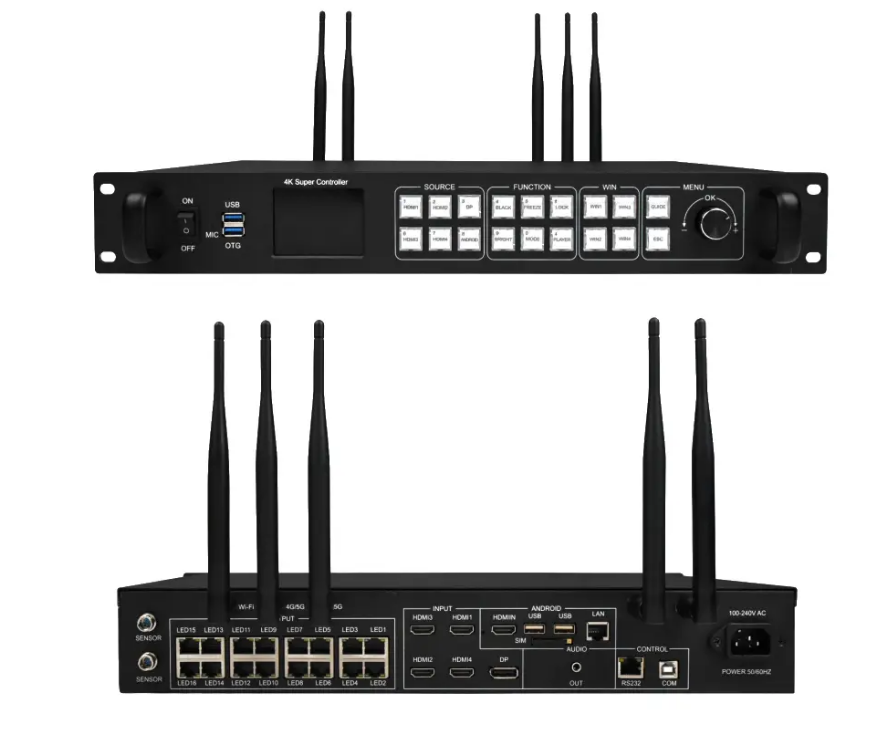
Huidu HD-A7 vs HD-A8 4K: Full Analysis of Parameters, Performance, and Applications
Huidu HD-A7 and Huidu HD-A8 are dual-mode 4K LED display controller models designed for projects that require both synchronous input and asynchronous playback. Although they share similar architecture and system design, their loading capacity, output ports, and scalability are different. This guide breaks down the key technical differences between these two Huidu controller models to help you understand how they fit into real LED display systems.
1.HD-A7 and HD-A8 4K LED Display Controller Introduction
Huidu HD-A7 and HD-A8 are advanced LED display controllers that support both synchronous and asynchronous playback modes. You can switch between standalone playback from internal storage and real-time mirroring of live HDMI or DP signals as needed. These controllers are built to handle 4K video decoding and multi-window display, allowing you to play one 4K video or up to four 1080P videos simultaneously. With support for H.265/HEVC and other major formats, they deliver smooth, high-quality visuals for large-scale commercial LED screens such as hotels, shopping malls, conference rooms, and exhibitions.
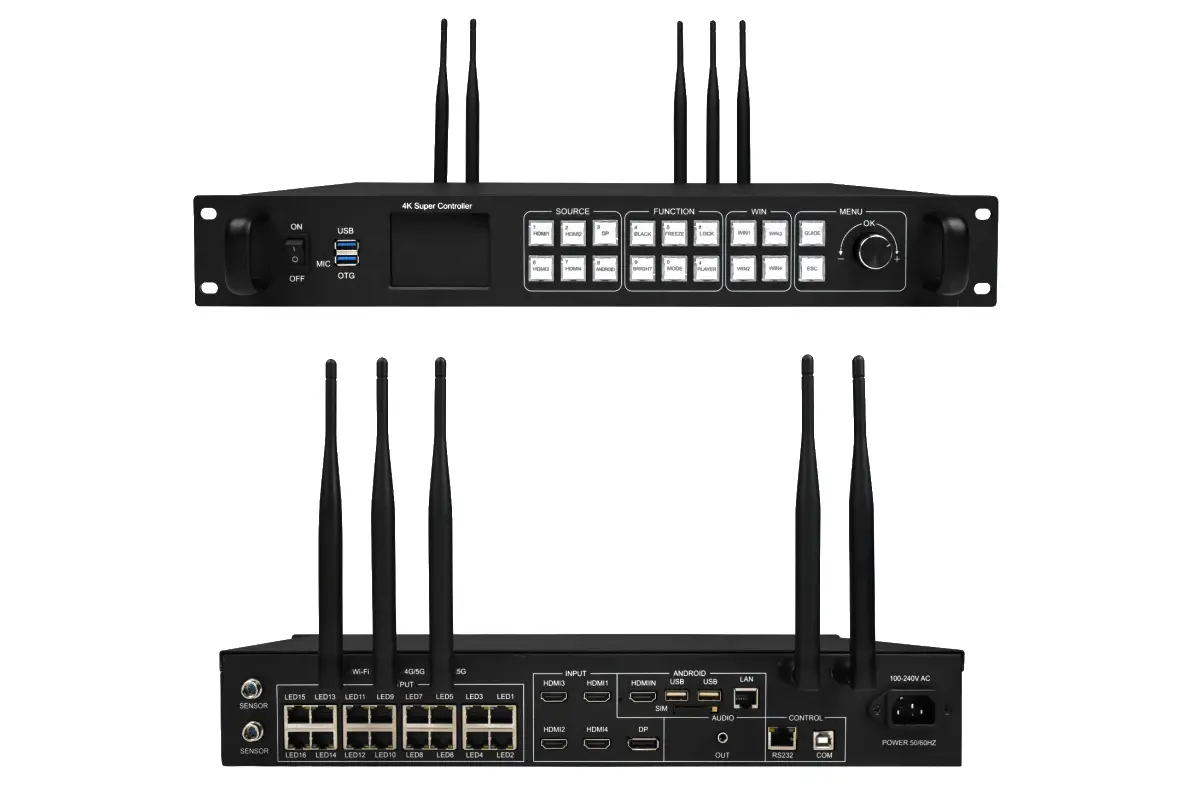
What Huidu controllers HD-A7 and HD-A8 Have in Common
Both the HD-A7 and HD-A8 Huidu controllers share a robust core feature set:
- Dual-frequency Wi-Fi (2.4GHz and 5GHz) for flexible wireless connectivity.
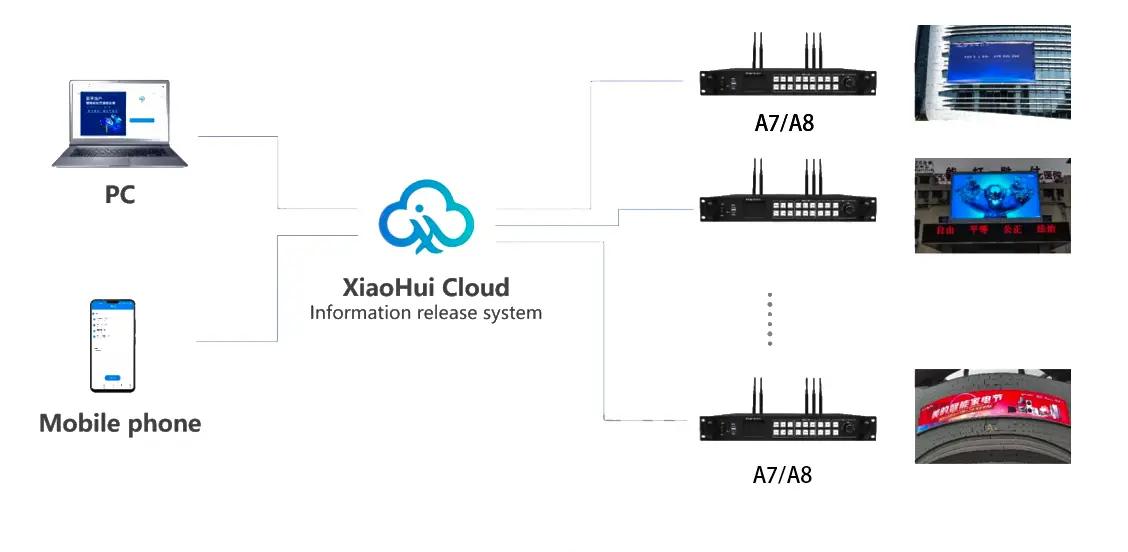
- Mobile app control and integration with the “XiaoHui Cloud” platform for remote cluster management.
- Onboard 32GB storage (expandable via USB) for ample content storage.
- Multi-format media support, including video, images, office documents, and more.
- Optional 4G/5G modules for internet-based remote access.
- Sensor interfaces for connecting environmental monitoring devices (brightness, temperature, etc.).
2.Huidu controller HD-A7 vs HD-A8 Comparison
| Feature | HD-A7 | HD-A8 |
| Pixel Loading Capacity | Asynchronous: 5.16M pixels, Synchronous: 5.2M pixels | Asynchronous: 8.29M pixels, Synchronous: 10.4M pixels |
| Output Ports | 8 Gigabit output network ports | 16 Gigabit output network ports |
| Video Decoding | Supports 4K@30fps, 1080P@60fps | Supports 4K@60fps, 1080P@60fps |
| Multi-Window Playback | Up to 4 windows | Up to 4 windows |
| Optional Features | 4G/5G module, wireless casting | 4G/5G module, wireless casting |
| Best Use Cases | Medium-sized LED screens | Large-scale LED walls |
3.How Do These Huidu Controllers Handle Synchronous and Asynchronous Playback?
Both the HD-A7 and HD-A8 are dual-mode LED display controllers, meaning they support both asynchronous playback from internal storage and synchronous input from live sources. Here’s how they compare:
Synchronous Mode
In synchronous mode, the controller acts as a pass-through for live HDMI or DP signals, mirroring content from computers, set-top boxes, or cameras in real time.
- HD-A7: Supports up to 5.2 million pixels with a maximum width of 16,000 pixels.
- HD-A8: Supports up to 10.4 million pixels with the same maximum width of 16,000 pixels.
- Use Case: Ideal for live events, conferences, and broadcast studios where timing and real-time display are critical.
Both models support auto-scaling of the input signal to match your screen resolution, and you can switch between multiple input sources as needed.
 100vw, 1110px” data-dt-location=”https://www.eagerled.com/huidu-controllers-hd-a7-hd-a8/huidu-controllers-hd-a7-and-hd-a8-synchronous-mode-2/” data-lazy-src=”https://www.eagerled.com/wp-content/uploads/2026/02/Huidu-controllers-HD-A7-and-HD-A8-synchronous-mode-1.webp” /></div>
</figure>
</div>
<div id= "Huidu controllers HDA7 and HDA8 synchronous mode LED Display Manufacturer in China EagerLED")
Asynchronous Mode
In asynchronous mode, the controller works as a standalone LED player, playing content stored on its 32GB internal memory or a connected USB drive.
- HD-A7: Handles up to 5.16 million pixels with a maximum width of 65,536 pixels.
- HD-A8: Handles up to 8.29 million pixels with the same maximum width of 65,536 pixels.
- Use Case: Perfect for daily advertising loops, information displays, and scheduled content where a live feed isn’t required.
 100vw, 1085px” data-dt-location=”https://www.eagerled.com/huidu-controllers-hd-a7-hd-a8/huidu-controllers-hd-a7-and-hd-a8-asynchronous-mode/” data-lazy-src=”https://www.eagerled.com/wp-content/uploads/2026/02/Huidu-controllers-HD-A7-and-HD-A8-asynchronous-mode.webp” /></div>
</figure>
</div>
<div id= "Huidu controllers HDA7 and HDA8 asynchronous mode LED Display Manufacturer in China EagerLED")
Mixed Mode
Both Huidu controller models also support mixed playback, allowing you to display asynchronous content alongside a live synchronous input—for example, running a background advertisement while showing a live presentation in a picture-in-picture window.
4.4K Video Decoding and Multi-Window Performance on LED Display
Both the HD-A7 and HD-A8 support 4K video decoding with hard decoding technology for smooth playback.
The main difference is in frame rate: the HD-A8 handles 4K at 60fps, while the HD-A7 supports 4K at 30fps. This makes the HD-A8 a better fit for high-frame-rate content like sports broadcasts, live events, or fast-paced animations, where motion smoothness matters. For most commercial content such as advertisements and information loops, the HD-A7’s 30fps performance is perfectly adequate.
Both LED player models support a wide range of video formats, including H.265/HEVC, H.264, MPEG-4, VP9, and more, in containers like MP4, AVI, MKV, and MOV. This ensures compatibility with most common media files without requiring format conversion.
Multi-Window Capabilities
Both Huidu controller models support up to four simultaneous windows, allowing you to display multiple types of content on the same screen at once. For example:
- A live video feed in one window
- A scrolling text ticker in another
- Static images or GIFs in the remaining windows
This feature is especially useful in environments like shopping malls, hotel lobbies, or conference rooms where diverse content needs to be displayed together. You can mix live inputs with pre-programmed content, or combine videos, images, and text in a single layout.
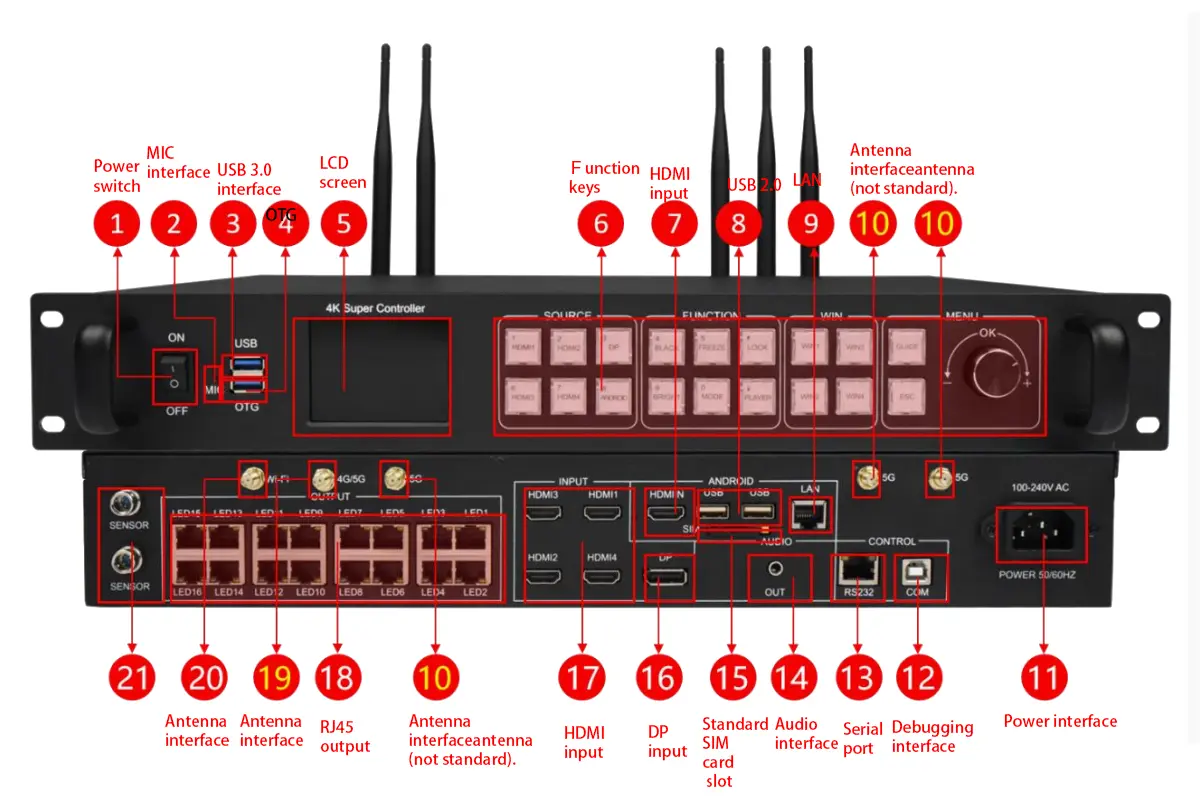
5.Input and Output Interfaces of the HD-A7 and HD-A8 LED Display Controller
Here’s a breakdown of the input and output interfaces for both models:
| Interface Type | HD-A7 | HD-A8 |
| Input Ports | 5 HDMI, 1 DP, 1 LAN, 3 USB HOST, 1 USB OTG | 5 HDMI, 1 DP, 1 LAN, 3 USB HOST, 1 USB OTG |
| Output Ports | 8 Gigabit RJ45 | 16 Gigabit RJ45 |
| Audio Output | 1 TRS 3.5mm dual-channel | 1 TRS 3.5mm dual-channel |
| Sensor Inputs | 2 sensor inputs | 2 sensor inputs |
- HDMI IN for Mixed Playback: Both models include a dedicated HDMI IN port that allows you to combine live synchronous input with asynchronous content. You can display a live feed and pre-programmed content simultaneously in picture-in-picture mode.
- USB Ports Serve Different Purposes: USB 3.0 ports are for program updates and storage expansion, while the USB OTG port is for debugging and firmware upgrades. You can publish content using a simple U-disk without any network connection.
- Sensor Inputs for Automation: The two sensor inputs support brightness sensors for auto screen adjustment, as well as temperature, humidity, and GPS modules for environmental monitoring and time synchronization.
6.Remote Control Options on HD-A7 and HD-A8 LED player
Remote control is a standout feature of both LED player models, offering multiple ways to manage your LED displays from anywhere.
Wireless Control
Both models come with dual-frequency Wi-Fi (2.4GHz and 5GHz) for direct wireless control via mobile apps. They also support STA mode, allowing the controller to connect to your local Wi-Fi network. For internet-based remote management, you can add optional 4G/5G modules and access the XiaoHui Cloud platform to manage multiple screens across different locations from a single dashboard.
Screen Projection
Both controllers offer optional wireless screen projection from smartphones or tablets, enabling you to cast content directly onto the LED display. This is useful for impromptu meetings, presentations, or quick content sharing without going through the full program publishing process.
Voice Control
Both models include voice control functionality, allowing hands-free operation for tasks like adjusting brightness or switching programs. The MIC interface on the front panel is where you connect the microphone for voice input.
Program Publishing Options
You can publish content to either Huidu controller in multiple ways:
- Via network cable using HDPlayer software on your computer
- Via Wi-Fi for wireless updates
- Via U-disk (FAT32 format) – simply export your program to a USB drive and plug it in. No internet or computer needed at the display location.
7.Which Huidu LED Display Controller Should You Choose: HD-A7 or HD-A8?
Choosing between these two LED display controllers comes down to your project scale and performance needs. Here’s a simple guide to help you decide:
Choose the HD-A7 if:
- For medium-sized LED screens: The HD-A7 handles up to 5.2 million pixels, covering most standard commercial displays like hotel lobby screens, retail store signage, and conference room walls.
- For standard video content: With 4K at 30fps, the HD-A7 delivers smooth playback for advertisements, information displays, and scheduled content loops.
- For cost-conscious projects: The HD-A7 offers the same core features as its bigger sibling—Android 10.0, 32GB storage, dual-band Wi-Fi, and XiaoHui Cloud support—at a more accessible price point.
Choose the HD-A8 if:
- For large-scale LED installations: With support for up to 10.4 million pixels in synchronous mode, the HD-A8 can drive expansive video walls, outdoor billboards, and stadium displays.
- For fast-moving video content: The HD-A8’s 4K at 60fps ensures smooth motion for sports broadcasts, live events, and high-frame-rate animations without stuttering.
- For complex screen layouts or future expansion: The 16 output ports provide flexibility for higher refresh rates, redundant cabling, or adding more screen modules down the line.
Final Thought
Both Huidu controller models deliver reliable performance and smart features. For fixed-size installations with standard content needs, the HD-A7 is a smart choice. For projects requiring higher pixel capacity, smoother motion, or room to grow, the HD-A8 is worth the investment.