Brightness Refresh Rate and Scan Design: How Outdoor LED Screens Really Work
Why can some outdoor screens be read effortlessly at noon and others disappear into glare? Why do some walls flicker on camera and others record clean? The answers sit in three engineering choices — brightness, refresh rate, and scan design. This article explains how the ASE10 outdoor LED advertising screen handles all three, and what that means for what your audience actually sees.

Brightness: Beating the Sun Is a Contrast Problem
Daylight illuminance reaches 100,000 lux. A screen must emit enough light — and critically, keep enough contrast against its own surface — to remain legible against that flood. The ASE10’s >5000-nit output is calibrated for the worst case: direct sun on the panel face, where a lower-spec screen shows a gray, washed-out image precisely when foot and vehicle traffic peaks.
Brightness alone is not the whole story; the quality of the black state and the LED’s optical packaging determine how much of that 5000-nit ceiling translates into perceived contrast. This is why two “5000-nit” screens can look entirely different side by side at 2 p.m.
Refresh Rate: What the Camera Sees
The human eye integrates light smoothly, but cameras sample it in slices. A screen refreshing at a low rate produces banding and flicker lines in every phone photo — and today, every viewer is a broadcaster.
| Visual Effect | ASE10 Behavior |
|---|---|
| Naked-eye motion | Smooth at 1920 Hz refresh |
| Smartphone photos | No visible scan lines |
| Video recording | Stable, broadcast-friendly footage |
| Slow-motion capture | Minor artifacts only at extreme frame rates |
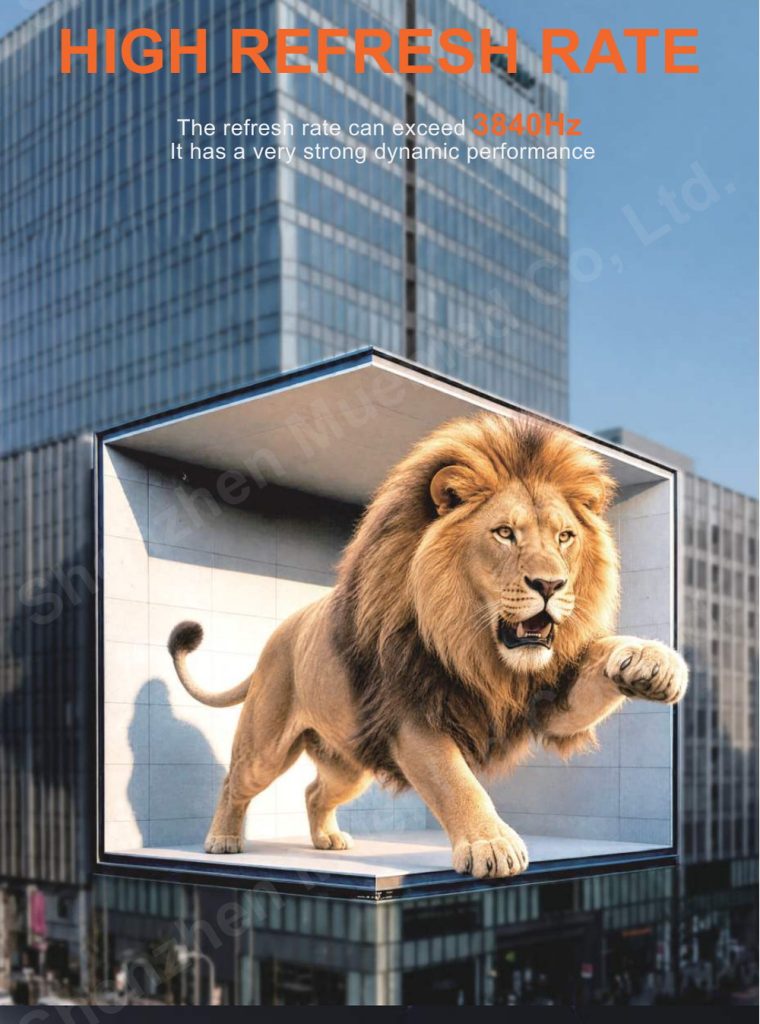
At 1920Hz, the ASE10 sits above the classic 960Hz commercial baseline: video looks fluid to live audiences and records cleanly for the social-media exposure every modern screen silently earns its owner.
Scan Design: The Hidden Variable
Inside the cabinet, LEDs are driven in groups — the scan ratio. The ASE10 uses 1/4 scan: each group of diodes is energized one quarter of the time, at proportionally higher efficiency.
The engineering trade-offs favor exactly what outdoor screens need:
- Lower peak current per LED — slower luminance decay over years
- Reduced heat — the sealed 960×960×145mm cabinet stays within thermal limits during 12–16 hour duty cycles
- Power supply headroom — the Muen units run well below their ratings, extending their own service life
Control: The Novastar Ecosystem
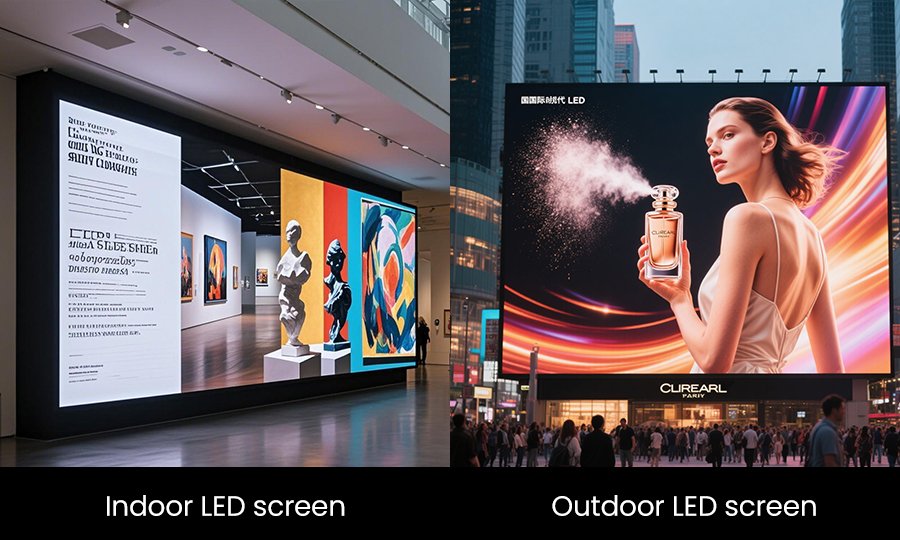
Every visual parameter above is managed through the Novastar control system: per-cabinet brightness calibration, automatic day/night dimming schedules, and color consistency across the entire face. Because Novastar is the industry’s standard platform, your operators inherit mature software tools and any technician can maintain the system without vendor-specific training.
Putting It Together
A screen is a system: LED choice sets the brightness ceiling, scan design determines how kindly the electronics age, refresh rate decides how the wall photographs, and the control platform keeps it all calibrated for a decade. The ASE10’s specification — >5000 nits, 1920Hz, 1/4 scan, Novastar — is a coherent answer to each question in turn. Explore the complete configuration on the product page.