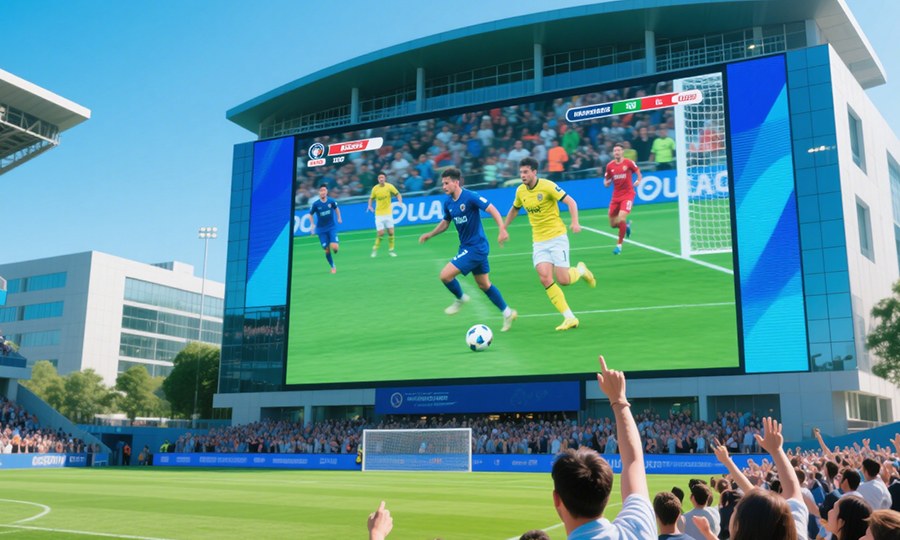
Why LED Screens Show Sharp Live Sports Footage Even in Direct Sunlight
Watching a live sports game in stadiums or outdoor public spaces on a giant screen is an exhilarating experience. The roar of the crowd, the thrill of the action, and the ability to follow every pass, goal, or touchdown in real-time make public viewing events unforgettable.
But there’s a catch: bright sunlight can make screens appear washed out, colors muted, and details nearly invisible. If you’ve ever tried to check your phone at the beach, you know the struggle of fighting a losing battle against the sun. This is where LED technology shines literally. Thanks to innovations in brightness, display design, and advanced engineering, LED screens ensure spectators don’t miss a single moment, no matter how harsh the sun may be.
The secret sauce isn’t just “brightness”—it’s a combination of raw power, contrast, and specialized hardware.

The Challenge of Outdoor Viewing
Sunlight is both a blessing and a curse for outdoor sports. While fans love to watch events under clear skies, natural light creates glare, reduces contrast, and can make screens look dull. Traditional display technologies—like LCD TVs or projectors—struggle in these conditions. LCD screens rely on backlighting that can be overpowered by the sun, while projectors require controlled darkness to achieve clarity. In live sports settings, where visibility is critical, these limitations are unacceptable. Spectators demand a vibrant, high-contrast viewing experience, and LED screens deliver exactly that.
What Makes LED Displays Stands Out
Extremely High Brightness (Measured in Nits)
The biggest challenge outdoors is ambient sunlight, which can reach 10,000–100,000 lux or more on a sunny day and easily “wash out” normal screens. Outdoor LED displays counter this with much higher luminance:
- Typical indoor LED or LCD screens: 500–1,200 nits.
- Outdoor LED screens for stadiums/sports: 5,000–10,000 nits (or higher, up to 12,000+ nits in some high-end models).
This means the screen’s own light output is strong enough to compete with (or exceed) direct sunlight, keeping colors vivid and details visible. Modern LED systems also feature automatic brightness adjustment. Which dynamically adjust output based on real-time ambient light, saving energy at night while maximizing visibility during the day.
Self-Emissive Technology (Each Pixel Produces Its Own Light)
Unlike LCD/LED-backlit TVs or projectors (which rely on a backlight or external light source that gets overwhelmed by sun), LED displays use tiny light-emitting diodes (LEDs) as the actual pixels. Each red, green, and blue LED lights up independently. This contrasts sharply with LCD screens, where light passes through layers, often reducing vibrancy in bright conditions.
Self-emissive technology allows LED panels to maintain bold visuals and accurate hues outdoors. This direct light emission provides excellent contrast and prevents the image from looking faded, even in full daylight. Whether it’s the bright green of the field or the team’s colorful uniforms, every detail remains true to life.

Anti-Glare and Surface Engineering
Brightness is only half the battle. If the sun hits a flat surface, it creates glare that washes out the image. Outdoor screens use louvers or shaders—tiny, black horizontal “visors” above each row of LEDs. These cast small shadows over the diodes to keep the background black.
Manufacturers also employ surface engineering to combat glare. Matte coatings and light-diffusing surfaces minimize reflections from the sun, while panel structures are designed to handle intense ambient light without losing clarity.
This maintains a high contrast ratio, ensuring the green of the turf or the colors of the jerseys stay saturated instead of looking grey. Those engineering ensures that spectators don’t have to shield their eyes or move around to see the action.
Motion Performance for Sports
Fast-paced sports demand more than just brightness and contrast. Sports involve fast action like players running, and balls flying. A split second can make all the difference between a goal and a miss. That’s why the screen must handle rapid movement without blur or lag.
LED displays typically support high refresh rates (often 3,840 Hz or more) and excellent motion processing. It’s offer high refresh rates that reduce motion blur, ensuring smooth playback of high-speed action. This ensures that even when a 100 mph fastball zooms across the screen, the image remains fluid and flicker-free.
This precision makes it easier for viewers to track every moment, creating a more immersive and satisfying experience.
Built for the Outdoors
LED screens are engineered to endure outdoor conditions. They are weatherproof, resisting rain, dust, and heat.
While your phone might overheat in 20 minutes of sun, these displays have integrated cooling systems and heat-dissipating aluminum frames to keep the electronics from “melting” under the intense workload. Cooling systems and thermal management prevent overheating during long hours of sun exposure, while robust construction ensures longevity even under constant use.
This durability is why LED technology is the standard for stadiums and outdoor fan zones, where screens must perform flawlessly regardless of the elements.
Suitable Resolution and Pixel Pitch for Viewing Distance
“High-definition” here doesn’t always mean ultra-fine 4K up close like a home TV. In large stadiums or public spaces, pixel pitch (distance between pixel centers) is often 4–10 mm for outdoor screens. This is coarser than indoor fine-pitch (1–3 mm) but perfect for long viewing distances. Fans in the stands or on the field see a sharp, seamless image without noticing individual pixels.
Modern outdoor LEDs can still achieve effective HD or even 4K-equivalent resolution across massive surfaces (tens or hundreds of square meters), with vibrant color and detail for sports broadcasts, replays, and scoreboards. Smaller pixel pitches are increasingly available for closer viewing areas while maintaining high brightness.
Large-Scale Modular Design
One of the remarkable features of LED screens is their modularity. Built from tile-based panels, LED walls can scale to enormous sizes while maintaining resolution and clarity. Stadiums, fan zones, and public event spaces can expand the screen as needed without sacrificing image quality.
This modular design also simplifies maintenance and customization, allowing venues to adapt displays for different events and crowd sizes.
Real-World Applications
LED technology isn’t just a convenience—it’s essential for public viewing events. From stadium screens that bring the action closer to fans in every seat, to outdoor fan zones and public broadcasts in city squares, LED screens transform how audiences experience live sports. Advertisers and broadcasters also benefit, as the technology allows dynamic content to be displayed in bright, clear conditions, reaching massive audiences.
LED vs Other Display Technologies
When compared to LCD, OLED, and projectors, LED screens dominate outdoor settings. Unlike LCDs, LEDs are self-emissive and brighter; unlike OLEDs, they are more robust and scalable for very large sizes; and unlike projectors, they perform perfectly even under direct sunlight. This combination of visibility, durability, and size flexibility makes LED the ultimate choice for outdoor sports events.
Future Developments
The evolution of LED technology continues at a rapid pace. Advances in microLED and smaller pixel pitch designs promise higher resolutions and sharper visuals. Energy efficiency improvements reduce power consumption without sacrificing brightness, while AI-driven systems optimize brightness and visuals dynamically. The result? Even more immersive and adaptive viewing experiences for outdoor audiences.
Conclusion
In short, ordinary TVs or projectors fail outdoors because they can’t generate enough light or handle glare.
From high brightness and self-emissive technology to anti-glare coatings, motion optimization, and robust weatherproofing, LED screens are purpose-built for outdoor sports viewing. They overcome sunlight, scale to stadium-sized displays, and deliver a crystal-clear, immersive experience that other technologies simply cannot match. That’s why you see crystal-clear live games, slow-motion replays, and ads on massive jumbotrons even at midday in bright sunshine.