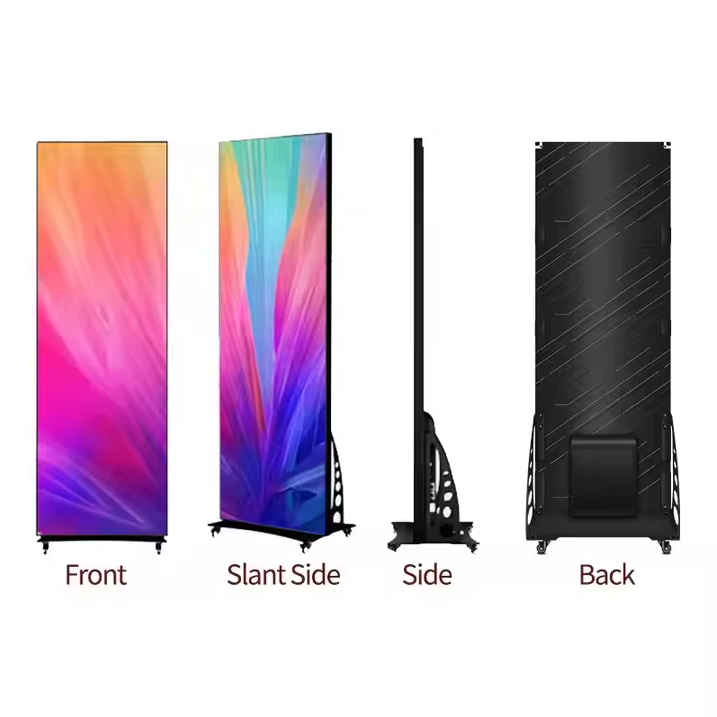
The Digital Poster Revolution: Your Guide to LED Display Screens
An LED poster display offers a sharper, brighter, and more versatile way to present visual content in stores, events, and public spaces. Today, many buyers search for a clearer understanding of what this technology is and why it matters for modern communication.
However, traditional posters and LCD screens often fail in bright environments, and they limit the type of content you can deliver. Businesses now face higher pressure to capture attention, streamline updates, and communicate with impact across multiple locations.
In this guide, you will learn how LED poster displays work, why they outperform older signage, and how you can use them to elevate visibility and drive measurable business results.
What Is an LED Poster Display?
An LED poster display is a slim, self-contained digital signage unit that uses high-brightness LED modules to deliver clear visual content in almost any lighting condition. It functions as a portable, plug-and-play digital poster designed for retail, events, and high-traffic indoor spaces, providing dynamic visuals that outperform traditional printed or LCD posters. Typically, most units include integrated controls, built-in media players, and multiple connectivity options, allowing you to update content quickly and manage several displays at once.
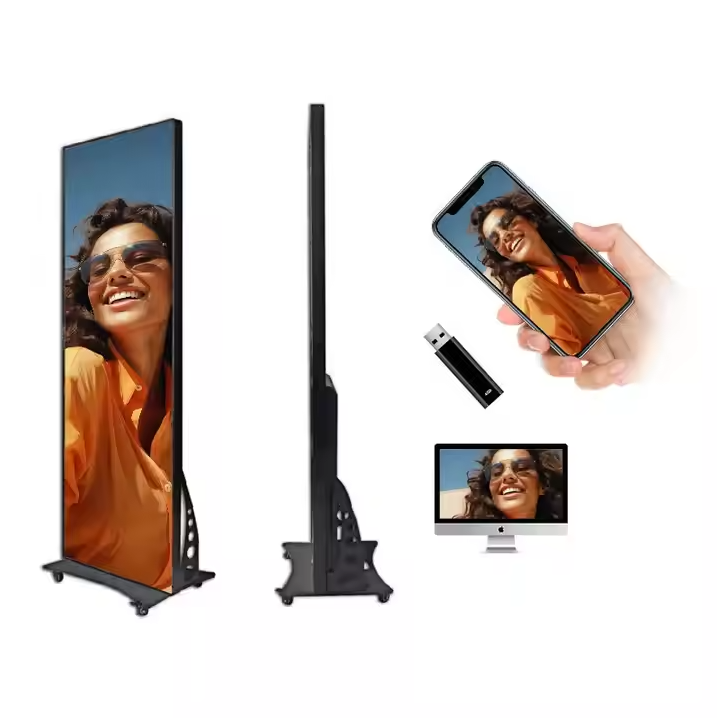
At its core, an LED poster uses light-emitting diodes arranged on fine-pitch modules to produce vivid images and motion graphics. Its high brightness makes it readable from long distances, and its durable structure supports frequent relocation. You can place it at entrances, product zones, lobbies, or public corridors to attract attention, promote offers, or guide visitors. Because of this, businesses value LED posters since the unit arrives pre-configured, requires minimal setup, and offers long operating life with relatively low maintenance costs.
Definition & Core Components
An LED poster display consists of several key parts that work together to create a stable and high-quality digital image.
• LED Modules: These panels contain pixel clusters that determine brightness and clarity. Fine-pitch modules (P1.8–P3.0) are common for indoor posters.
• Control System: Most units support WiFi, USB, LAN, and cloud control. This system manages content playback and screen synchronization.
• Power Supply: A compact, efficient power unit ensures stable operation for long daily runtimes.
• Frame and Stand: A lightweight aluminum frame supports the display, while foldable or wheeled stands improve mobility.
• Media Player: Many posters include a built-in player that handles images, videos, and playlists without external hardware.
These components work together to maintain stable brightness, smooth playback, and long-term reliability for commercial use.
Standard Sizes and Configurations
Manufacturers typically follow standardized height-to-width ratios to ensure consistent viewing performance. The most common size is approximately 640 mm × 1920 mm, which creates a tall portrait layout suitable for storefronts and event entrances. In some cases, models offer slightly wider or narrower cabinets depending on the pixel pitch and structural design.
LED posters also support multiple installation configurations. You can use them as free-standing displays for retail promotions, wall-mounted units for narrow corridors, or hanging screens for high-visibility areas. Additionally, many models support horizontal rotation, allowing you to convert the screen into a landscape orientation for wider content formats.
Businesses with larger display needs can also splice several posters side by side. This modular flexibility lets you scale a single unit into a multi-screen video wall without replacing any hardware, reducing long-term investment and simplifying future upgrades.

Key Benefits of LED Poster Displays
LED poster displays deliver several advantages that help businesses communicate clearly and consistently in demanding environments. As a result, their brightness, mobility, and operational efficiency make them a practical choice for retail, events, and public venues that rely on high-impact visual messaging.
Superior Brightness & Visibility in High-Ambient Light
- LED posters maintain brightness levels of 800–1,200 nits, significantly higher than typical LCD posters.
• This output ensures clear visibility under strong indoor lighting, near glass storefronts, or in sunlit atriums.
• High contrast and wide viewing angles help your content stay readable from different distances and directions.
Plug-and-Play Convenience (ready in 2 minutes)
- Most units arrive preassembled with built-in media players and controlled access ports.
• You can power the poster, load content via USB, WiFi, or cloud, and begin displaying promotions within minutes.
• This workflow reduces installation downtime and supports quick content changes in fast-paced environments.
Multi-Screen Splicing for Large Displays
- LED posters can align seamlessly to create extended panoramic screens.
• You can combine two to six units to form a wider digital canvas for product launches, conferences, or retail campaigns.
• The synchronized playback feature keeps content consistent across all connected screens.
Energy Efficiency & Low Operating Cost
- LED technology converts energy more efficiently than LCD backlighting systems.
• Lower heat generation reduces the need for cooling and extends component lifespan.
• Over long operating cycles, this efficiency helps businesses control electricity and maintenance expenses.
LED Poster vs. LCD Poster: Which One Is Better for Your Business?
Below is a clear comparison of LED posters and LCD posters to help you identify which option fits your commercial environment more effectively.
| Feature / Factor | LED Poster Display | LCD Poster Display |
| Brightness | 800–1,200 nits; stays visible in strong ambient light | 350–700 nits; often washed out near windows or bright areas |
| Viewing Angle | Wide angles with consistent brightness | Narrower angles; color shifts more noticeable |
| Content Flexibility | Supports motion graphics, large formats, and multi-screen splicing | Best for static visuals and limited motion content |
| Installation | Plug-and-play; portable stands and multiple mounting options | Requires more fixed mounting and often heavier units |
| Durability | Solid-state LEDs with long lifespan and low risk of screen burn | More prone to backlight wear and panel degradation |
| Energy Efficiency | High efficiency with lower heat output | Higher power consumption for comparable brightness |
| Scalability | Seamless splicing to form larger displays | Limited scalability; bezels disrupt multi-screen visuals |
| Best Use Cases | Retail entrances, events, exhibitions, bright environments | Indoor corridors, meeting rooms, controlled lighting spaces |

Applications of LED Poster Displays Across Industries
LED poster displays fit a wide range of commercial environments because they combine portability, strong brightness, and easy content updates. Consequently, businesses adopt them to deliver timely promotions, guide visitors, and highlight brand messages without dealing with the limits of printed materials or low-brightness screens.
Retail & Shopping Malls
Retailers use LED posters to highlight product launches, seasonal offers, and limited-time campaigns. The high brightness helps stores capture attention near entrances, especially in spaces with glass storefronts. Shopping malls also place LED posters in corridors or atriums to promote events and guide foot traffic toward anchor stores.
Exhibitions & Trade Shows
Exhibitors rely on LED posters to stand out in crowded halls where each booth competes for visibility. The slim structure fits limited booth spaces, and multi-screen splicing supports larger product showcases. Exhibitors can update content instantly during the show to match live demonstrations or adjust schedules.
Restaurants & Hospitality
Restaurants use LED posters at entrances to display menus, promotions, and real-time updates. Hotels place them in lobbies or conference floors to communicate events, welcome messages, and wayfinding instructions. The ability to refresh content remotely helps staff maintain consistent brand communication throughout the day.
Corporate Lobbies & Brand Communication
Companies install LED posters in reception areas to present corporate stories, visitor greetings, or compliance messages. The modern form factor enhances the professional atmosphere of the lobby, while scheduled content allows different departments to share information throughout the week. This approach strengthens brand identity for both employees and guests.
Transportation Hubs (Airports/Stations)
Airports and train stations use LED posters to publish service alerts, directional messages, and commercial promotions. Because these locations have strong ambient light, LED brightness offers a practical advantage. The posters’ narrow footprint also supports placement in busy corridors without blocking movement.
Events, Conferences & Entertainment Venues
Event organizers deploy LED posters at entrances, ticketing zones, and breakout rooms to display agendas, sponsor content, or crowd guidance messages. Entertainment venues use them to showcase upcoming performances or seat-section instructions. Their mobility allows staff to reposition the screens quickly as crowd patterns shift.
Installation, Setup & Maintenance
• First, perform a site assessment to identify viewing distance, ambient light levels, and foot traffic.
• Then, assemble and power the unit by unfolding the stand, locking the frame, and plugging it into a standard outlet.
• Next, upload content via USB, Wi-Fi, or cloud CMS and schedule updates as needed.
• To maintain clarity, wipe the surface regularly with a dry cloth and avoid chemicals.
• Periodically, check power supplies, cables, and firmware versions.
• When necessary, replace LED modules quickly thanks to modular serviceability.

Conclusion
LED poster displays offer a clear advantage for businesses that need strong visibility, flexible content control, and reliable performance in challenging lighting conditions. Overall, their modular structure, fast setup, and long operating life make them a practical upgrade from traditional signage.