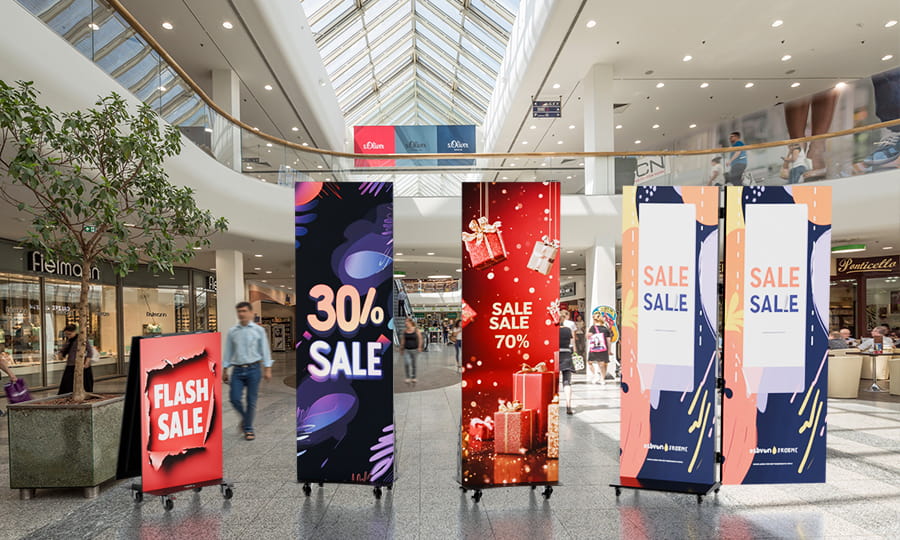
LED Posters vs. Foldable LED Posters: 6 Key Differences
In today’s fast-paced world of digital advertising, traditional static posters and banners are quickly being replaced by vibrant, eye-catching LED displays. LED posters—slim, high-resolution digital screens that can play videos, animations, and dynamic images—have become a go-to solution for retailers, event organizers, exhibitors, and marketers who want to grab attention and deliver impactful messages.
Among the many options available, two standout variants dominate the market: the standard LED poster and the newer foldable LED poster.
A standard LED poster is a rigid, portable standalone display, typically floor-standing with optional wheels or wall-mountable. It’s lightweight, easy to move within a space, and delivers stunning visuals with plug-and-play simplicity.
The foldable LED poster takes portability and flexibility to the next level. Thanks to its innovative hinged or modular design, it can be folded compactly for transport, unfolded into a large seamless screen, or even configured as a double-sided display—making it incredibly versatile for frequent movers.
Both types offer brilliant brightness, high refresh rates, remote content management, and resolutions fine enough for close-viewing (often P1.5 to P2.5), far surpassing traditional printed posters or even LCD screens in visual impact.
Yet despite these shared strengths, the choice between a standard LED poster and a foldable one often comes down to specific needs. There are 6 key differences—ranging from design and portability to setup speed and display versatility—that can significantly affect performance, cost, and convenience.
In this article, we’ll break down each of these differences in detail, complete with real-world examples and visuals, to help you decide which type is the perfect fit for your retail space, trade show booth, event, or advertising campaign.
6 Key Differences: LED Poster vs. Foldable LED Poster
Difference 1: Design & Structure
The most fundamental distinction between a standard LED poster and a foldable LED poster lies in their physical construction.
A standard LED poster features a rigid, single-panel design. It typically uses a slim aluminum alloy frame (around 33–45mm thick) housing a fixed LED module, usually in common sizes like 640×1920mm. The structure is sturdy and seamless when deployed, but it remains one solid unit that cannot be altered in shape or size once assembled.
In contrast, a foldable LED poster incorporates a sophisticated hinge system—often a bi-fold or tri-fold mechanism—that allows the screen to fold along precise vertical axes. High-end models use advanced materials like glue-on-board (GOB) or chip-on-board (COB) encapsulation to protect the LEDs during repeated folding and unfolding. When fully opened, the display remains perfectly seamless with no visible gaps or bezels. The folding design not only reduces the footprint but also adds an extra layer of impact resistance, making it more resilient to bumps during transport.
This structural difference has practical implications: while standard posters prioritize simplicity and reliability for long-term installations, foldable versions are engineered for durability in dynamic, high-mobility environments.
(Standard LED poster: rigid single-panel construction)
(Foldable LED poster: close-up of hinge mechanism and seamless unfolded display)

LED Poster Displays
Difference 2: Portability & Storage
Portability is where the foldable LED poster truly shines.
Standard LED posters are lightweight (often 35–40kg) and come with wheels or a stable base, making them easy to move within a single location like a store or lobby. However, their rigid, full-size form factor makes them bulky for frequent transportation or limited storage space.
Foldable LED posters, on the other hand, can collapse to half (or less) their deployed width, dramatically reducing volume—often by up to 50%. This compact form fits easily into standard flight cases, cars, or small storage areas, cutting shipping and logistics costs significantly for rental companies or event organizers.
If your setup involves regular relocation, the foldable version saves time, money, and effort in handling.
Difference 3: Setup & Installation
Both types are designed for quick deployment, but foldable models take speed and convenience further.
Standard LED posters offer true plug-and-play: roll it into place, connect power and content source (USB, HDMI, WiFi), and you’re live in minutes. They’re excellent for fixed or semi-fixed spots but require handling the full-sized unit.
Foldable LED posters enable even faster single-person setup—often under 1 minute. Simply remove from the case, unfold, lock the hinges, stand it up, and power on. No tools needed, and the compact folded state makes maneuvering through doors or crowded venues effortless.
This makes foldables ideal for time-critical environments like trade shows or pop-up events.

Difference 4: Display Modes
Versatility in presentation sets the two apart.
Standard LED posters are typically single-sided, delivering content on one face. Multiple units can be spliced seamlessly to create video walls, but the configuration is fixed once installed.
Foldable LED posters offer multiple modes: fully unfolded for a large single screen, partially folded for angled views, or fully folded for true double-sided display—where each side can show independent content, perfect for hallways or central placements.
This creative flexibility allows foldables to adapt to different spaces and audience flows on the fly.
Difference 5: Advantages
Each type has strengths tailored to different priorities.
Standard LED posters benefit from simpler mechanics, often lower upfront cost, and proven reliability for continuous operation. They’re straightforward to maintain and excel in stable environments.
Foldable LED posters provide superior flexibility, enhanced protection (anti-collision and sometimes IP-rated), and significant savings on transport/storage over time. Their innovative design reduces wear from handling.
Both share core advantages: ultra-bright visuals (3000–5000 nits), fine pixel pitches for sharp close-up viewing, app/remote content control, and energy efficiency compared to traditional signage.
Difference 6: Best Use Cases
The right choice depends on your application.
Standard LED posters are perfect for permanent or semi-permanent installations where the display stays in one place—retail stores, shopping malls, airports, hotels, or corporate lobbies.
Foldable LED posters dominate in mobile scenarios: trade shows, exhibitions, conferences, pop-up shops, rentals, or any event requiring frequent setup/teardown and transport.

Conclusion
To recap the 6 key differences: design & structure, portability & storage, setup & installation, display modes, advantages, and best use cases.
If you need a reliable, cost-effective solution for a fixed location with stunning visuals, go with a standard LED poster.
For maximum mobility, quick reconfiguration, and versatility across events, the foldable LED poster is the clear winner.
Both represent the cutting edge of digital signage, delivering dynamic content that captivates audiences far better than static alternatives. Choose based on your mobility needs, budget, and environment—and you’ll have a powerful tool to elevate your advertising or messaging for years to come.