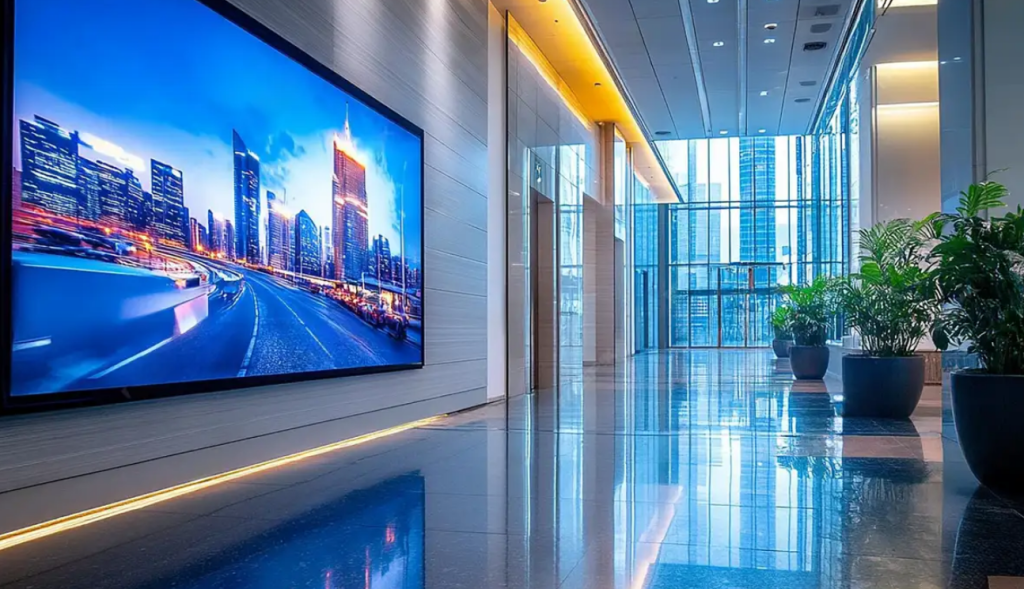
Exhibition Hall LED Display Sizes: Key Dimensions and Selection Factors
Designing an exhibition hall often starts with one central question: how large should the LED display be? Many organizations want an immersive visual centerpiece, yet struggle to determine the right size for their space. Exhibition halls differ widely in layout, audience density, and viewing distance, which makes the decision even more complex.
This article clarifies the typical LED display sizes used in exhibition halls and explains how factors such as hall dimensions, pixel pitch, and content type influence the final choice.
By the end, you will understand how to choose a display size that enhances your exhibition experience while staying practical, scalable, and visually impressive.

What Is the Typical Size of LED Displays Used in Exhibition Halls?
In most exhibition halls, LED displays commonly range from 100 inches to over 300 inches, depending on the type of content and viewing distance. The majority of professional exhibition halls use LED screens between 10m² and 60m², though some large halls exceed 100m² for immersive environments.
These sizes work well because they balance visual impact with audience visibility and hall proportions.
The reason LED screens vary so widely is that exhibition halls do not follow a standard layout. Some are narrow with short viewing distances, while others are wide, open, and designed for large groups. The screen size must therefore adapt to:
- The overall dimensions of the exhibition hall
• The distance between visitors and the screen
• The type of display used (LED vs LCD videowall)
• Pixel pitch and required resolution
• Content format (text, images, video, data visualization)
Key Factors That Determine LED Display Size in Exhibition Halls
1. Exhibition Hall Dimensions
As a general rule, a larger exhibition hall requires a larger display. A screen that is too small will look insignificant, while a screen that is too large may overwhelm the space or distort the viewing experience.
Typical hall size → Recommended LED display area
| Exhibition Hall Size | Visitor Capacity | Recommended LED Display Size |
| < 50 m² (small) | < 20 people | 100″ – 150″ (4–8 m²) |
| 50–120 m² (medium) | 20–50 people | 150″ – 250″ (8–20 m²) |
| 120–300 m² (large) | 50–120 people | 250″ – 350″ (20–40 m²) |
| > 300 m² (extra-large) | 120+ people | 350″ and above (40 m²+) |
Large exhibition halls often use curved, ultra-wide, or immersive LED walls that extend across the main display area.
2. Visitor Viewing Distance
Viewing distance is a major factor in choosing both screen size and pixel pitch. If the audience stands too close to the screen, the display may appear pixelated. If they stand too far, small text becomes difficult to read.
A widely accepted LED formula is:
Recommended viewing distance ≈ Pixel pitch (mm) × 1–1.5
For example:
• P2.5 LED → best viewing distance: 2.5–3.5 meters
• P1.5 LED → best viewing distance: 1.5–2.2 meters
• P4 LED → best viewing distance: 4–6 meters
Closer viewing distances require smaller pixel pitch, which also allows larger screens while maintaining clarity.

Choosing the Right Display Type for Exhibition Halls
Exhibition halls commonly use two types of large displays: LED screens and LCD video walls.
LED Displays
LED displays are assembled using small modules (e.g., 320×160mm), allowing full flexibility in size and shape.
Advantages
• No visible seams
• Highly customizable
• Supports giant or irregular shapes
• Suitable for bright exhibition halls
• Long lifespan and stable performance
• Able to create immersive curved or 3D installations
Best for:
Large exhibition halls, creative content, immersive rooms, brand presentations.
LCD Videowalls
LCD videowalls use large panels—typically 46”, 49”, 55”, or 65”—combined in a grid such as 2×2 or 3×3.
Advantages
• High resolution (ideal for close viewing)
• Lower cost for smaller installations
• Excellent color accuracy
Disadvantages
• Visible bezel lines between panels
• Limited size flexibility
• Not suitable for oversized or curved displays
Best for:
Small or medium exhibition rooms requiring fine detail.

How LED Module Sizes Affect Final Display Dimensions
Because LED displays use modular construction, manufacturers can build nearly any size.
Common LED module sizes:
• 320 × 160 mm
• 250 × 250 mm
• 300 × 168.75 mm
This modular system allows:
- Custom aspect ratios
• Wall-to-wall installation
• Creative shapes (curved, cube, arch, ribbon)
This flexibility is why LED displays dominate large exhibition halls, with typical completed sizes ranging from 5 meters to 15 meters in width.
Typical LED Display Dimensions for Exhibition Halls
Below is a helpful reference for the most common screen sizes selected by exhibition designers:
| Application Type | Typical Size | Notes |
| Small corporate exhibition area | 120–180 inches | Ideal for P1.8–P2.5 screens |
| Medium-sized brand/enterprise halls | 180–260 inches | Ideal for P2.0–P2.5 screens |
| Government or technology exhibition halls | 260–350 inches | Suitable for P2.5–P3.0 screens |
| Large immersive exhibition halls | 6–12 meters wide | Often curved or ultra-wide |
| Experience centers / demo zones | 8–20 meters wide | Full LED walls |
Most exhibition designers choose screens between 3m × 2m and 8m × 4m, depending on the hall’s architecture and the function of the display.

Additional Considerations When Choosing LED Display Size
1. Content Type
Different content requires different resolutions and screen sizes.
- Data charts / text-heavy content → Higher resolution, smaller pixel pitch
• Brand storytelling video → Larger screens, wider aspect ratios
• Interactive displays → Smaller viewing distance, tighter pixel pitch
• Immersive visual rooms → Large, curved LED walls
2. Ceiling Height and Structural Load
The exhibit hall must support the total weight of the LED screen and allow safe installation.
Typical LED display weight:
• 25–40 kg/m² depending on pixel type
• Ultra-light cabinets available for suspended installations
3. Ambient Light
Bright exhibition halls may require high-brightness LED displays (1000–2000 nits).
LCD videowalls are less suitable in strong lighting conditions.
4. Budget Considerations
Pixel pitch, size, and brightness significantly affect cost.
For example, a P1.5 LED wall costs more than double a P3.0 wall of equal size.

Conclusion
Choosing the right LED display size for an exhibition hall starts with evaluating the room dimensions, viewing distance, and content needs. Most halls use screens between 100–300 inches, while larger immersive spaces may require custom-sized LED walls for better visual impact.