A complete guide on how to choose the appropriate type of LED display screen
There are many types of LED displays, but the key to choosing the right one doesn’t lie in the parameters — it lies in the application scenario.
This article explains the key differences in application, packaging, pixel pitch, and installation.
It will help you quickly grasp what sets each type apart and choose the one that fits your needs best.
1. What Is an LED Screen?
In the era of digital communication, LED displays have become an indispensable core device for information presentation and visual communication.
They use Light Emitting Diodes (LEDs) to emit light directly, converting electrical energy into bright images and vibrant colors.
With high contrast, strong brightness, and flexible splicing capability, LED displays are now one of the most mainstream large-screen display technologies.
They offer several key advantages:
① High brightness and contrast: Clear and visible even in bright or outdoor environments.
② Seamless splicing and flexible sizing: Freely combined to create screens from a few to thousands of square meters.
③ Long lifespan and energy efficiency: LED light sources last long and consume little power, ideal for long-term use.
④ Adaptability across multiple scenarios: Depending on the environment, LED displays can be classified as indoor, outdoor, rental, transparent, or floor-mounted types.
Thanks to these features, LED displays have become an essential medium for modern commercial showcases, public information display, and immersive experiences.

2. Main Types of LED Display and Their Classifications
2.1 LED Screen Types by Application
Different application scenarios determine the structure, brightness, protection level, and maintenance approach of LED displays.
The table above summarizes the most common types and their typical use cases.
Different application scenarios determine the structure, brightness, protection rating, and maintenance method of LED displays. Below are the most common types and their typical applications:
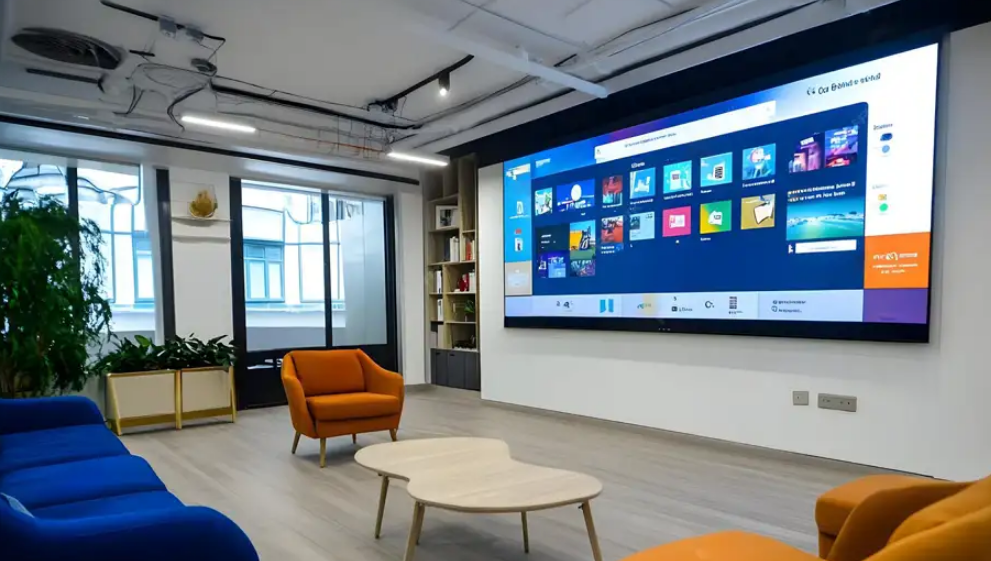
2.1.1 Indoor LED Display
Mainly used in meeting rooms, control centers, and retail showrooms where lighting conditions are controllable.
The focus is on pixel precision and color consistency, with brightness typically ranging from 600 to 1200 nits.
Indoor LED displays usually adopt a front-maintenance design, allowing for wall-embedded or integrated installation.

2.1.2 Outdoor LED Display
Featuring high brightness (≥5000 nits) and an IP65 protection rating, outdoor displays are built to withstand direct sunlight, rain, and harsh weather.
They are widely used for billboards, stadiums, and building façades, and require excellent heat dissipation and anti-corrosion performance.

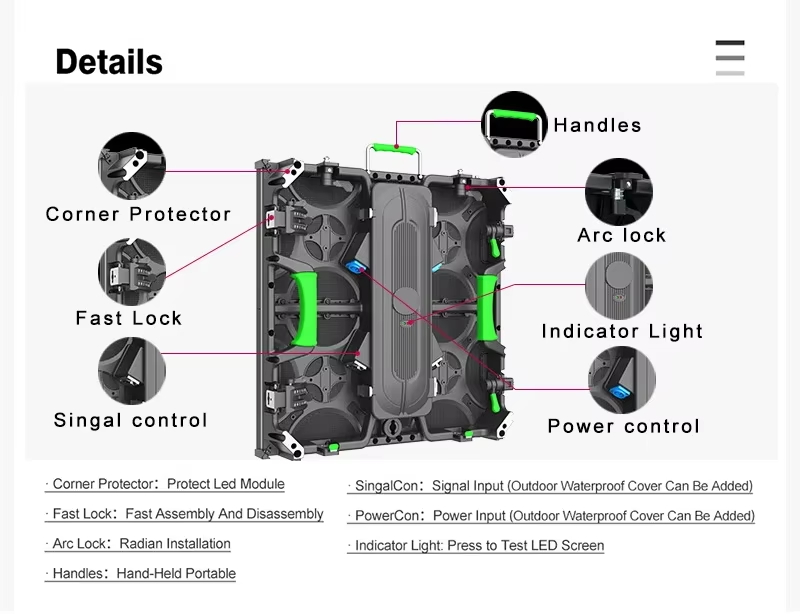
2.1.3 Rental LED Display
Designed for events, stages, and exhibitions that require frequent setup and teardown.
These displays are lightweight, equipped with quick-lock mechanisms, and support both front and rear maintenance.
For rental LED screens, the key performance factors are structural stability and assembly efficiency, rather than brightness.

2.1.4 Transparent LED Display
Ideal for glass windows, shopping mall façades, and exhibition spaces, with a transparency rate of 50%–80%.
It allows natural light to pass through while providing vivid advertising visuals — a popular solution balancing aesthetics and functionality in retail and architectural design.
2.1.5 Flexible LED Display
Composed of flexible PCBs and soft LED modules, this type can bend or curve to fit creative or irregular surfaces.
Common in art installations, curved walls, and immersive exhibition spaces, it demands high precision in driving consistency and custom structural design.

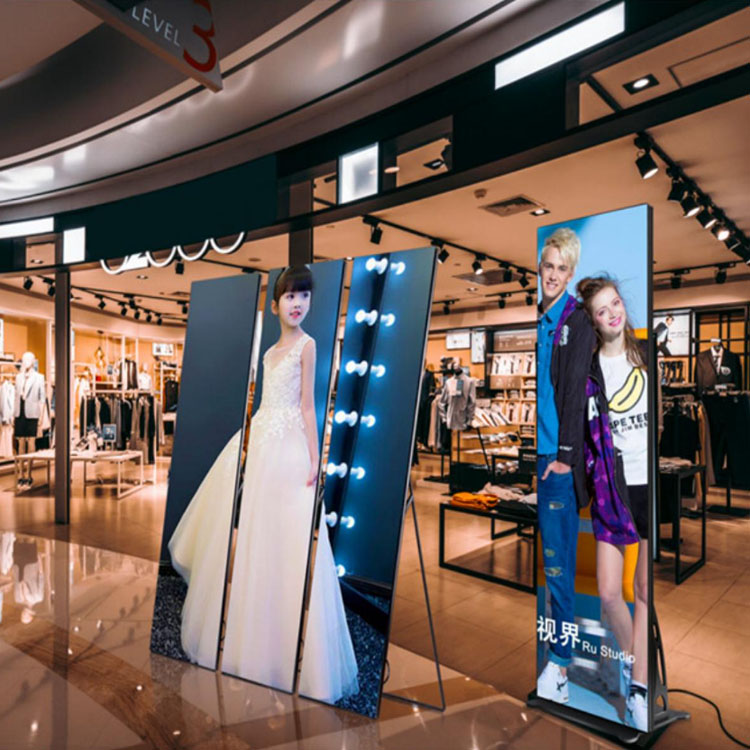
2.1.6 LED Poster Display
A plug-and-play, all-in-one LED advertising screen, ideal for retail promotions and brand launches.
Lightweight and portable, it supports Wi-Fi control and serves as a high-brightness alternative to LCD poster displays.
2.1.7 Floor LED Display
Specifically designed for floor-based and interactive applications, featuring anti-slip, impact-resistant, and moisture-proof structures.
Commonly used in exhibition halls, immersive spaces, and interactive stage floors.
Table 1: LED Display Types & Specifications
| Type | Typical Scenarios | Brightness Range (nits) | Installation Method | Maintenance Method |
| Indoor Display | Meeting rooms, showrooms, shopping malls, command centers | 800–1500 | Wall-mounted / Embedded | Front maintenance |
| Outdoor Display | Billboards, stadiums, commercial plazas | 5000–8000 | Pole-mounted / Hanging | Rear maintenance |
| Rental Display | Stages, exhibitions, live events | 1500–3000 | Quick-lock structure | Front & rear maintenance |
| Transparent Display | Shop windows, glass façades, exhibition spaces | 2500–5000 | Rear-mounted / Freestanding | Rear maintenance |
| Flexible Display | Curved walls, creative installations, museums | 1000–2000 | Curved or customized structure | Front maintenance |
| Poster Display | Retail stores, promotional events | 800–1500 | Freestanding / Mobile stand | Front maintenance |
| Floor Display | Shopping malls, interactive stages | 1500–3000 | Floor-embedded | Top maintenance |
2.2 LED Display Types by Technology
In the early days, LED displays were typically classified by color output—monochrome, dual-color, or full-color.
Today, however, nearly all commercial LED displays adopt a full-color RGB architecture.
What truly determines color performance is not the color type, but rather the packaging technology and the bit-depth control capability of the driver circuit.
Currently, the four mainstream technologies are DIP, SMD, COB, and GOB—each with its own strengths in brightness, protection, and application suitability.
Table 2: Key Parameters and Characteristics of LED Packaging Technologies
| Technology Type | Principle Overview | Brightness Performance | Protection / Impact Resistance | Typical Lifespan | Main Application Scenarios |
| DIP (Dual In-line Package) | Individual LED lamps are soldered directly onto the PCB; highly robust structure. | Ultra-high brightness (~7,000–10,000 nits) | Medium (IP65 / IK07) | ≥100,000 h | Outdoor billboards, large-scale installations |
| SMD (Surface Mounted Device) | RGB three-in-one surface-mount packaging with high pixel density. | High (~4,000–6,000 nits) | Medium (IP54) | ≥80,000 h | Indoor/outdoor general use, rental displays |
| COB (Chip On Board) | LED chips are directly bonded to the substrate without lead-frame encapsulation. | Medium (~3,000–4,000 nits) | Excellent (IP65+, outstanding impact resistance) | ≥100,000 h | Fine-pitch displays, control rooms |
| GOB (Glue On Board) | A protective resin layer is applied over SMD modules to enhance durability. | High (~4,000–5,000 nits) | Excellent (IP65, moisture-proof and impact-resistant) | ≥90,000 h | Rental and interactive displays |
Each packaging technology offers a different balance of brightness, durability, and cost, making it suitable for specific installation and environmental needs.
2.2.1 DIP LED Display
Uses traditional dual in-line packaging (DIP346 / DIP576). Each pixel consists of separate red, green, and blue lamps, offering extremely high brightness and excellent environmental adaptability.
Advantages:
Ultra-high brightness (up to 7,500–10,000 nits), strong resistance to water and UV radiation, long lifespan, and outstanding operational stability.
Disadvantages:
Relatively large pixel pitch and narrow viewing angle; color uniformity and image fineness are inferior to SMD technology.
Typical Applications:
Outdoor billboards, large stadium screens, traffic information boards, and public information displays.
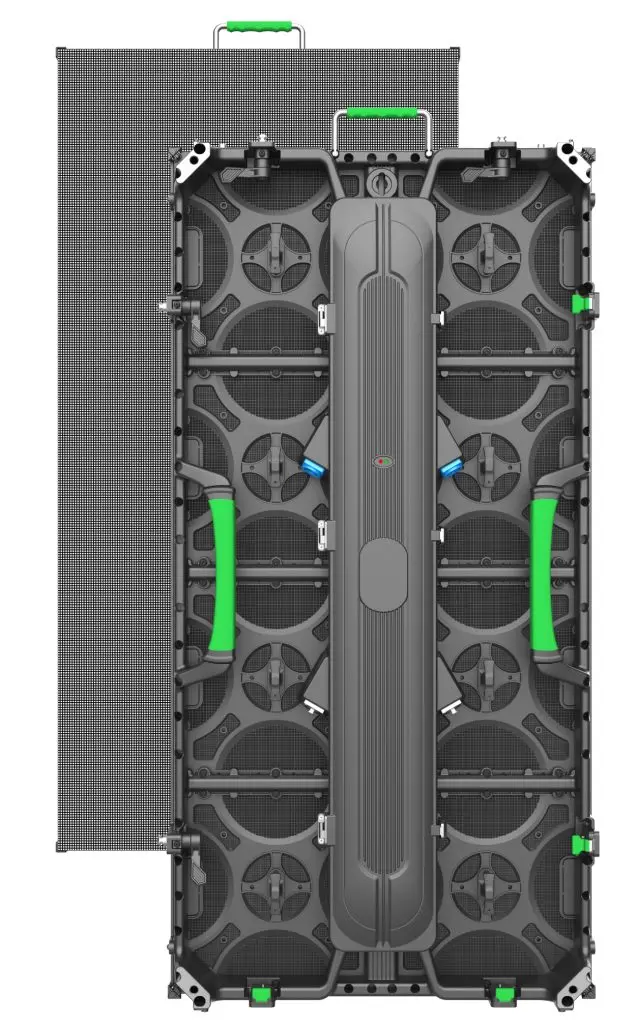
2.2.2 SMD LED Display
SMD (Surface-Mounted Device) integrates RGB chips within a single package, resulting in a more compact pixel arrangement and improved color uniformity.
Advantages:
High color accuracy, wide viewing angle (≥140°), fine image detail, and lightweight structure — ideal for high-resolution displays.Disadvantages:Lower resistance to moisture and impact; requires additional protective design and more demanding maintenance for outdoor applications.
Typical Applications:
Indoor advertising screens, stage backdrops, conference displays, rental displays, and retail showcases.
1000K.4 (1)
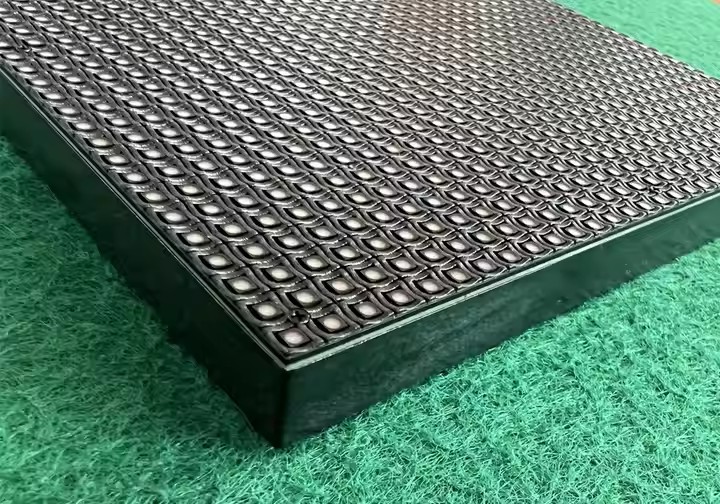
2.2.3 COB LED Display
COB (Chip on Board) technology directly bonds LED chips onto the PCB substrate without lead frames, creating a smooth, continuous light-emitting surface.
Advantages:
Exceptional protection against dust, moisture, impact, and static electricity; highly reliable with excellent heat dissipation, high contrast, smooth surface, and simplified maintenance.
Disadvantages:
Complex manufacturing process and higher maintenance cost; if one chip fails, the entire module typically needs replacement.
Typical Applications:
High-end fine-pitch displays, control rooms, security monitoring centers, exhibition halls, and command centers.
615
2.2.4 GOB LED Display
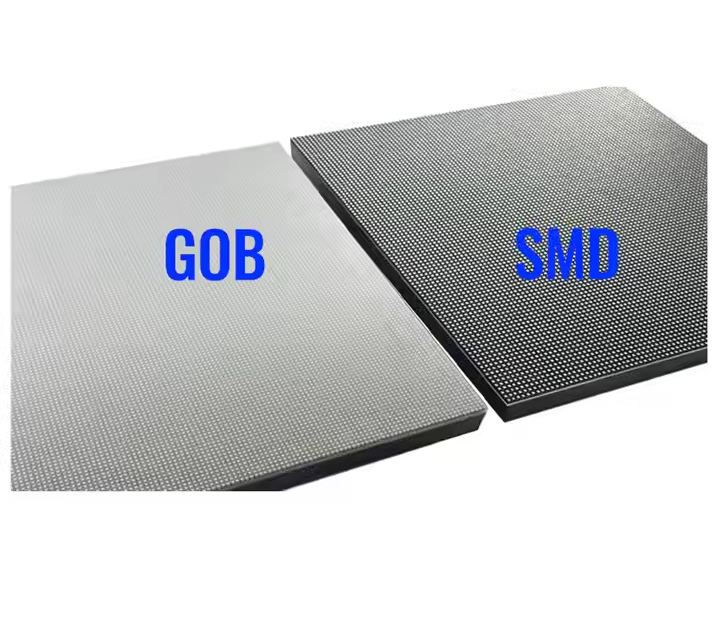
GOB (Glue on Board) applies a transparent protective resin layer over the SMD module surface, combining SMD’s high image quality with COB’s superior durability.
Advantages:
Strong resistance to moisture, impact, dust, and UV radiation; excellent reliability and color performance, ideal for frequent transport or challenging environments.
Disadvantages:
The resin coating slightly affects heat dissipation, and brightness decay may occur more quickly in high-temperature environments over time.
Typical Applications:
Rental stage screens, exhibition displays, interactive installations, floor displays, transparent screens, and other mobile display setups.
企业微信截图 20241113160359
With the continuous advancement of LED display technologies, COB and GOB are emerging as the next-generation packaging trends, excelling in fine-pitch resolution, enhanced protection, and long operational lifespan.
2.3 LED Panel Types by Installation and Maintenance Method
Understanding LED display types by their installation and maintenance structure helps you choose the right setup for your project.
Different installation methods affect setup efficiency, ease of maintenance, and applicable scenarios.
2.3.1 Fixed Installation
Designed for long-term or permanent installations.
The display is mounted onto a wall or supporting frame and connected through fixed cabling.
Advantages:
Stable and reliable, neat cable management, and relatively low maintenance cost.
Typical Applications
Indoor/outdoor advertising, building façades, shopping malls, and conference rooms.

2.3.3 Front and Rear Maintenance
Defines the direction from which display modules are accessed and serviced.
Front Maintenance: Modules can be maintained from the front side—ideal for wall-mounted or space-limited installations.
Rear Maintenance: Modules are serviced from the back—suitable for large, freestanding structures.
Dual Maintenance: Supports both front and rear servicing, offering flexibility for premium installations that require both aesthetics and convenience.
Tip:
For tight or enclosed spaces, choose front maintenance.
For open or structural installations, rear maintenance is more practical.

2.4 By Pixel Pitch
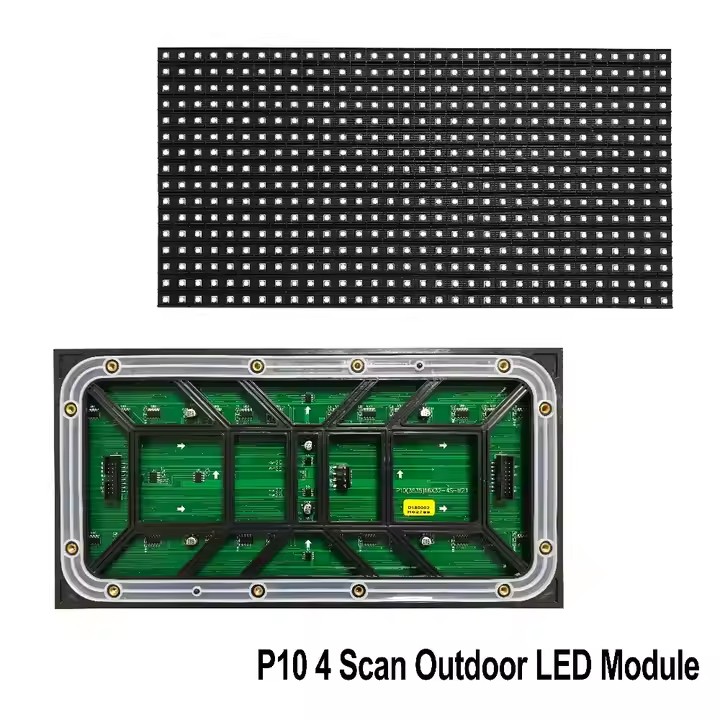
Pixel pitch refers to the distance between the centers of two adjacent pixels (measured in millimeters). It is a key factor determining display clarity and visual smoothness.
A smaller pixel pitch delivers higher pixel density and finer image quality—but also increases cost.
(1) Fine Pixel Pitch (P0.9–P2.5)
Provides ultra-high-definition and smooth visuals even at close viewing distances.
Ideal for control rooms, conference rooms, and premium indoor displays.
(2) Medium Pixel Pitch (P2.6–P4.8)
Balances image detail and cost efficiency.
Commonly used in retail spaces, exhibitions, and rental stage displays.
(3) Large Pixel Pitch (>P5)
Optimized for high brightness and long-distance visibility.
Typically used for outdoor billboards, stadium screens, and large-scale installations.
002
For a deeper understanding of how pixel pitch affects LED display clarity and viewing distance, check out our full article:
“LED Screen Pixel Pitch: How to Choose the Right One”
3. How to Choose the Right Type of LED Display
Choosing the right type of LED screen should start with your project needs, rather than being driven solely by technical specifications.
The following scenario-driven approach helps turn project requirements into actionable selection decisions.
3.1 Key Questions to Simplify Your Decision
Answering the following three questions will greatly streamline the selection process:
- Is the display for indoor or outdoor use?
Determines brightness and protection rating. - What is the viewing distance and screen size?
Determines the appropriate pixel pitch. - Is the display permanent or frequently moved/rented?
Determines cabinet design and locking mechanisms.

Matching Input Size & Installation Location to Pixel Pitch and Packaging Type
Tip: For a full design recommendation, contact our engineering team to get a free configuration plan.
3.2 Quick Selection Guidelines
① Indoor / close viewing distance: Prioritize fine-pitch displays.
② Outdoor / long viewing distance: Prioritize high-brightness displays (DIP or outdoor SMD).
③ Stage / event use: Choose lightweight rental cabinets.
④ Aesthetic or transparency requirements: Consider transparent or flexible displays.
Table 3: Scenario-Based Recommendation
| Scenario | Recommended Type | Key Features |
| Meeting room / Control center | Fine-pitch indoor display (P1.2–P2.5) | Ultra-high resolution, uniform color, front-maintenance capable |
| Outdoor advertising / City screens | DIP or high-brightness SMD (P4–P10) | Ultra-high brightness, IP65+ protection, strong weather resistance |
| Stage / Concert / Exhibition | Rental cabinet (commonly P2.6–P4.8) | Lightweight, quick-lock installation, vibration & transport resistant |
| Retail window / Storefront | Transparent LED or fine-pitch semi-transparent solution | Semi-transparent visuals, balances light transmission and image display |
| Floor / Interactive display | Durable protective design (GOB / reinforced modules) | Impact-resistant, anti-slip, water-resistant design |
4. Key Considerations Before You Invest in an LED Display System
Purchasing an LED display is not just about the unit price.
By considering total cost of ownership (TCO) and long-term performance, you can make a more informed and reliable choice.
Below are four critical factors to evaluate, along with actionable recommendations.

4.1 Refresh Rate and Controller Quality
Why it matters:
The refresh rate determines the stability and flicker-free performance when captured by cameras or displaying fast-motion content. The controller affects color consistency and synchronization across the screen.
Implementation Suggestion:
For professional displays and live broadcasting scenarios, prioritize a full-screen refresh rate of ≥3840 Hz, especially for stage or TV broadcast environments.
Tip:
Beyond numerical values, consider whether the control system supports color calibration, zoned brightness adjustment, and remote management.
4.2 Power and Data Redundancy
Why it matters:
Commercial and critical applications (e.g., control rooms, outdoor advertising) require high availability. A single point of failure can lead to significant losses.
Implementation Suggestion:
Use dual power supply backup and redundant data paths (e.g., dual network ports or backup receiving cards) to ensure the display continues operating or switches seamlessly in case of a unit failure.
Tip:
Check power specifications, redundancy strategies, and whether hot-swappable modules are supported.
4.3 Maintenance and Serviceability
Why it matters:
Ease of maintenance directly affects operational costs and downtime. Modular displays that support front, rear, or dual maintenance are much more convenient in practice.
Implementation Suggestion:
Prioritize modular designs, easily replaceable modules, and simple color calibration procedures.
For installations with limited space, choose front-maintenance structures.
4.4 Cost vs Lifetime (TCO)
Why it matters:
The lowest purchase price does not equal the lowest cost. Lifespan, power consumption, and maintenance frequency all impact long-term expenditure.
Evaluation Method:
Consider power consumption (W/m²), expected lifespan (hours), warranty terms, and maintenance costs to calculate a 3–5 year total cost of ownership.
Tip:
Pay attention to LED and driver chip brands, module yield rates, and the manufacturer’s warranty and service response times.
Additional Technical Differentiation Recommendations
- Color Consistency & Calibration:
Check whether the display supports hardware-level 3D LUTor software batch color calibration, which is especially important for high-end showcase environments. - Heat Dissipation & Material:
Effective thermal management can extend the lifespan and reduce brightness decay. For outdoor displays, also consider UV resistanceand anti-corrosion coatings. - Control andCompatibility:
Prefer solutions compatible with mainstream control systems or open APIs, making it easier to integrate with third-party hardware or software. - Energy Efficiency andSustainability:
Lower power consumption and high-efficiency power supplies can significantly reduce long-term operational costs and support corporate ESG reporting. - Selection Principle:
When choosing a display, prioritize project goals, environmental conditions, viewing experience, and long-term operational costs.
Technical parameters—such as pixel pitch, packaging type, and refresh rate—should serve the scenario requirements, not dictate the choice.
Tip:
If you are evaluating specific solutions, we can provide a free, customized selection recommendation based on your usage scenario, viewing distance, budget, and maintenance requirements.
5. Conclusion
Choosing the right type of LED display means finding the optimal balance between clarity, brightness, cost, and lifespan.
A well-matched solution not only enhances the visual experience but also significantly reduces long-term maintenance and energy costs.
Still unsure which LED display is best for your project?