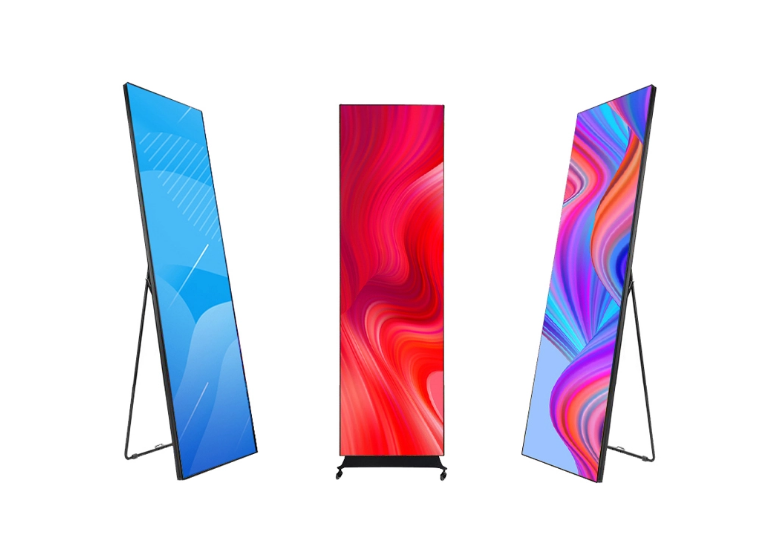
Pixel spacing selection strategy for indoor LED poster screens
Pixel spacing is the core indicator that determines the image quality and cost of indoor LED poster screens. This article will start from the basic principle of “viewing distance determines clarity”, deeply analyze the pixel spacing selection criteria in different application scenarios, and provide a set of simple calculation formulas. At the same time, common misconceptions such as blindly pursuing extremely small spacing will also be analyzed to help you find the best balance between budget, clarity, and power consumption, truly achieving rational procurement of “choosing right over expensive”.
Poster LED Display Pixel Pitch Explained — Beyond the Basic Definition
What Pixel Pitch Means in an Indoor Poster LED Display Context
Pixel pitch in a poster LED display determines how sharp the content appears at close range. Pixel pitch refers to the distance between two adjacent LED pixels, measured in millimeters, and in an indoor poster LED display, this measurement directly affects text clarity, image smoothness, and overall brand perception.
In commercial interiors such as shopping malls, retail stores, and corporate lobbies, audiences often stand within one to three meters of the screen. At this range, the difference between P1.95 and P2.5 becomes highly visible, especially when displaying small fonts or detailed visuals. Unlike outdoor billboards designed for long-distance viewing, a poster LED format operates in near-field environments where pixel density must match audience proximity.
Perceived clarity also depends on lighting, contrast, and content resolution. Therefore, selecting pixel pitch is not only a technical decision but also a strategic branding choice.
Why Poster LED Pixel Pitch Decisions Are Different from Standard LED Screens
Poster LED pixel pitch decisions differ from large LED video walls because of vertical layout and dynamic viewing behavior. A vertical LED poster screen is typically positioned at eye level, meaning viewers scan content quickly while walking past.
In high-traffic retail corridors or exhibition halls, content must be readable within seconds. If the pixel pitch is too large, small details blur during motion. If it is too small, costs increase without a measurable marketing gain. Vertical layouts with QR codes, product pricing, and promotional text demand careful resolution alignment. For this reason, poster LED applications require more precise pixel pitch evaluation than standard landscape screens.
Indoor Poster LED Viewing Distance — The Real Starting Point for Pixel Pitch Selection
Matching Pixel Pitch LED Display to Real-World Viewing Scenarios
Indoor poster LED viewing distance should guide pixel pitch LED display selection from the start. While the traditional guideline suggests one meter of viewing distance per millimeter of pixel pitch, real installations require contextual analysis.
For example, a P2.5 poster LED screen works well when the average viewing distance exceeds 2.5 meters. In large shopping mall atriums, this provides strong clarity at a reasonable investment. However, in boutique stores where customers stand less than two meters away, P1.8 or P1.95 produces noticeably smoother text and gradients.
Audience dwell time, store layout, and lighting conditions must all be evaluated before making a decision.
Case Study: Choosing Between P1.95 and P2.5 for a Retail Poster LED Installation
Choosing between P1.95 and P2.5 highlights how business context influences pixel pitch. In a high-end cosmetics boutique, customers examine packaging visuals up close. A P1.95 indoor poster LED display delivers fine text clarity and enhances premium perception.
In contrast, an electronics chain placing screens near entrances benefits from P2.5, where customers pass quickly and view content from greater distances. The lower pitch cost improves ROI without sacrificing visibility.
This comparison demonstrates that pixel pitch selection must align with brand positioning and user behavior rather than simply pursuing the smallest specification.
How Close Is Too Close? Avoiding Over-Specification in Indoor Poster LED Projects
Over-specifying pixel pitch in an indoor poster LED project can waste budget. Ultra-small pitch options offer excellent detail, but if customers never stand extremely close, the additional cost provides limited benefit.
By analyzing foot traffic patterns and content complexity, businesses can balance visual performance and investment efficiency.
Common Industry Pain Points When Selecting Poster LED Pixel Pitch
Blurry Text and Moiré Effect in Indoor Poster LED Displays
Blurry text in an indoor poster LED display often results from a mismatched pixel pitch and content resolution. When content is scaled improperly, visual artifacts appear.
Additionally, low refresh rate screens can create flicker when filmed by smartphones. Therefore, pixel pitch should be considered together with refresh rate and grayscale performance to ensure smooth visuals.
Overspending on Small Pitch LED for Short-Term Campaigns
Overspending on small-pitch LED is common in short-term marketing projects. A smaller pitch does not automatically increase engagement if the viewing distance remains moderate.
For seasonal promotions or temporary events, a mid-range pitch often achieves sufficient clarity while preserving budget.
Inconsistent Brightness vs Pixel Density — Achieving Visual Comfort
Balancing brightness and pixel density is critical in indoor Poster LED Displays. Excessive brightness can cause glare and discomfort in enclosed spaces.
Most indoor environments require moderate brightness to maintain clarity without visual fatigue. Optimizing both pixel pitch and brightness ensures comfortable and efficient operation.
Comparing Popular Pixel Pitch Options for Poster LED Applications
P1.8–P2.0 Indoor Poster LED Display for Ultra-Close Viewing
P1.8 to P2.0 indoor poster LED displays are suitable for ultra-close viewing environments such as luxury retail or corporate showrooms. Fine pixel density eliminates visible structure at short distances.
The GOB Slim Stand Led Digital Display Portable Fixed Led Video Wall Indoor Advertising Led Poster Display is designed for these scenarios. Its slim structure and stable image performance support premium indoor applications.
P2.5 Poster LED Screen — Balancing Clarity and Cost Efficiency
P2.5 poster LED screens provide balanced clarity and cost control for most commercial interiors. Shopping malls, airports, and chain stores often select this range for its reliable performance.
The LED Poster Screen series combines a stable refresh rate with consistent color output, ensuring smooth visuals in high-traffic spaces.
When a Larger Pixel Pitch Still Works for Indoor Poster LED
A larger pixel pitch can perform well in spacious indoor halls where viewing distances are longer. Trade show venues and atriums may not require ultra-small pitch.
The Smart LED Poster Display Screen offers flexible deployment and network control, making it suitable for dynamic commercial environments.
Poster LED Resolution, Content Strategy, and Real Commercial Impact
How Content Type Influences Pixel Pitch Requirements
Content type significantly influences pixel pitch requirements in a poster LED display. Text-heavy layouts demand higher pixel density, while bold imagery tolerates moderate pitch.
Marketing teams should align font size and animation complexity with hardware resolution to ensure clarity.
Vertical LED Poster Screen Resolution and Aspect Ratio Optimization
Vertical LED poster screen resolution must match portrait content design. Proper scaling prevents distortion and preserves image integrity.
Matching native cabinet resolution with content format maximizes visual performance and reduces artifacts.
Multi-Poster LED Cluster Installations — Maintaining Pixel Pitch Consistency
Multi-poster LED installations require a consistent pixel pitch across units. Retail chains deploying multiple screens must maintain uniform density to ensure seamless brand presentation.
Consistent calibration and refresh rate synchronization further enhance display reliability.

Poster LED Decision Framework — A Step-by-Step Selection Guide
Step 1: Define Viewing Distance and Audience Behavior
Viewing distance and audience movement patterns establish the foundation for pixel pitch selection.
Step 2: Evaluate Content Complexity and Brand Expectations
Content detail level and brand positioning determine whether a smaller pitch is justified.
Step 3: Align Pixel Pitch LED Display with Budget and Long-Term Goals
Budget planning should reflect installation duration and expected marketing impact.
Step 4: Consider Environmental and Installation Constraints
Lighting conditions and available space influence performance and installation flexibility.
How SRYLED Approaches Pixel Pitch Selection for Indoor Poster LED Projects
Engineering-Based Assessment Instead of Over-Specification
MuenLED evaluates pixel pitch selection through environmental analysis and application requirements rather than overspecification.
Performance Factors Beyond Pixel Pitch in a Poster LED System
Refresh rate, grayscale, and structural stability play essential roles alongside pixel pitch. High refresh rate ensures flicker-free visuals during smartphone recording.
Practical Recommendations for Retail, Exhibition, and Commercial Interiors
Retail boutiques benefit from finer pitch, while exhibition halls may prioritize mobility and cluster control. Our experience across commercial environments supports tailored solutions.
FAQ
Q: How to choose the right pixel pitch for an indoor poster LED display?
A: Selecting the right pixel pitch depends on viewing distance and content detail. Smaller pitch suits close viewing under two meters, while P2.5 works well for medium distances.
Q: What is the best pixel pitch for a poster LED screen in retail stores?
A: Retail stores often use P1.95 for close interaction areas and P2.5 for entrances or larger corridors.
Q: Is a smaller pixel pitch always better for an indoor poster LED display?
A: Smaller pitch increases clarity but also costs. If the viewing distance is moderate, mid-range pitch may be sufficient.
Q: P1.95 vs P2.5 poster LED display — which one is better?
A: P1.95 provides finer detail at close range, while P2.5 balances clarity and investment for slightly longer viewing distances.
Q: Which brand is recommended for indoor poster LED display projects?
A: Reliable brands should offer a high refresh rate, a stable structure, and consistent visual quality. SRYLED provides indoor poster LED displays designed specifically for commercial applications.