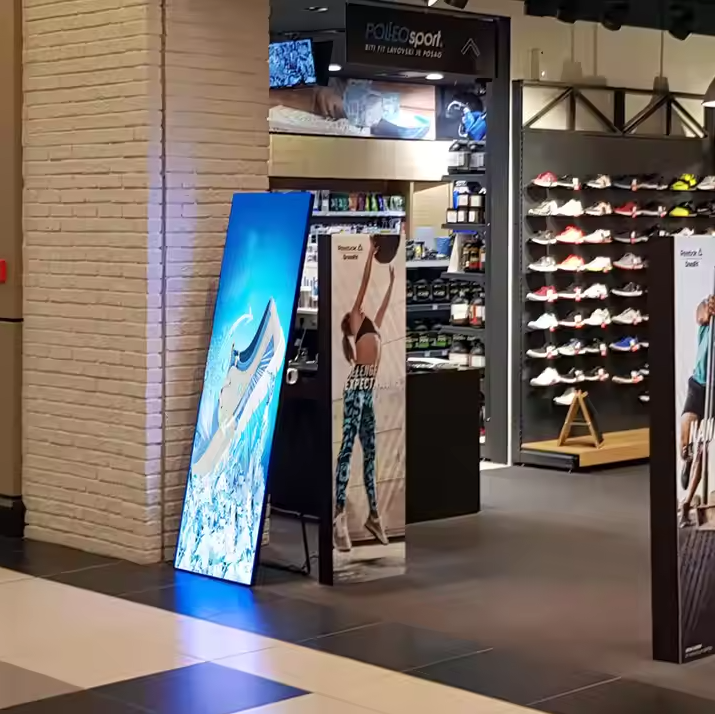
LED Posters vs Traditional Posters: How to Choose?
Advertising has always been about grabbing attention. From hand-painted signs to glossy printed posters, businesses have relied on visuals to communicate their message. Today, technology has introduced a new contender: LED posters. These digital displays promise dynamic visuals and modern appeal, but do they truly outperform traditional posters? This article explores both mediums. Comparing their strengths, weaknesses, and best-use scenarios to help businesses decide which option suits their needs.

What Are LED Posters?
LED posters are digital advertising displays that use light-emitting diodes to project vibrant, animated content. Unlike static prints, they can showcase moving graphics, videos, and interactive elements.
Where they’re used: retail & shopping malls, transportation hubs, events & exhibitions, hospitality industry, corporate & educational settings and etc.
Key features: high brightness, dynamic visuals, remote content updates, and the ability to run multiple campaigns on a single screen.
Appeal: They stand out in crowded environments, especially at night or indoors where lighting enhances their impact.

Poster LED
What Are Traditional Posters?
Traditional posters are printed advertisements on paper, vinyl, or other materials. They’ve been a staple of marketing for decades. Offering a simple and cost-effective way to reach audiences.
Where they’re used: storefronts, billboards, community boards, events, and grassroots campaigns.
Key features: static design, low production cost, and wide accessibility.
Appeal: Their familiarity and tangibility make them trusted by audiences, especially in local or small-scale campaigns.
LED Posters vs Traditional Posters: A Direct Comparison
LED posters are fundamentally different from traditional (printed) posters. With the primary distinction being that LED posters display dynamic, updatable, high-impact digital content. While traditional posters are static, printed graphics that cannot be changed without physical replacement.
Visual Impact
LED Posters: Bright, animated, and eye-catching. Motion and light naturally draw attention.
Traditional Posters: Relies on design, color, and placement. Effective but less dynamic.
Cost
LED Posters: Higher upfront investment in hardware, but savings over time since content updates are digital. (More read: What Are the Costs for LED Posters?)
Traditional Posters: Low upfront cost, but recurring expenses for reprinting and distribution.
Durability & Maintenance
LED Posters: Weather-resistant and long-lasting, but require technical maintenance and occasional repairs.
Traditional Posters: Vulnerable to fading, tearing, and weather damage, especially outdoors.
Audience Engagement
LED Posters: Interactive potential (QR codes, animations, touchscreens). Motion captures attention longer.
Traditional Posters: Familiar, trusted, and effective for local audiences who value simplicity.
| Comparison Point | LED Posters (Digital) | Traditional Posters (Printed) |
| Content | Dynamic (videos, animations, slideshows, real-time data) | Static (text and fixed images only) |
| Updates | Instant updates via Wi-Fi, USB, or cloud | Manual replacement (reprinting and reinstallation required) |
| Visual Impact | High brightness (up to 5,000+ nits), vibrant colors, visible in all lighting conditions (day and night) | Relies on ambient light or simple backlighting, can be hard to see in dim or very bright conditions, colors fade over time |
| Upfront Cost | Higher initial investment for hardware | Lower initial cost for design and printing |
| Long-Term Cost | Low (no recurring printing costs, minimal maintenance) | High (recurring costs for every content update and replacement) |
| Durability | Long lifespan (50,000-100,000 hours), weather-resistant, built for commercial use | Short lifespan, prone to fading, tearing, or weather damage (rain, wind) |
| Engagement | Significantly higher engagement due to motion and interactivity (touchscreens, QR codes) | Passive, one-way communication with no interactivity |
| Sustainability | Eco-friendly (eliminates paper waste, energy-efficient) | Contributes to waste (paper, ink, logistics) |
Case Studies & Real-World Examples
To better understand when LED posters or traditional posters work best, let’s look at a few scenarios.
Scenario 1: A Major Retailer in a Shopping Mall
A large retailer in a busy shopping mall wants to drive sales for its weekly “Deal of the Week” campaign. With heavy foot traffic and a need to attract impulse buyers, the store installs a freestanding, high-brightness LED poster right at the entrance. Every Monday morning, headquarters remotely pushes a new video highlighting the week’s promotion — for example, “50% off all jackets! Limited time only!” The vibrant visuals catch the eye of passersby and entice them into the store. A traditional poster would struggle here: printing and installing a new design every week would be costly and logistically complex. And the static image would likely be ignored by shoppers accustomed to digital stimulation.
Scenario 2: A Local Coffee Shop
A neighborhood coffee shop has a different goal. Displaying a permanent menu board with only occasional price changes or seasonal additions. For this purpose, a traditional printed poster or simple light box is the perfect solution. The upfront cost is low, and the menu items remain stable most of the time. When the shop introduces a new seasonal drink or adjusts a price, they simply print a new section to overlay the old one or replace the insert in the backlit frame. An LED poster would be unnecessary here. The shop doesn’t need dynamic video content, and managing a digital system for such infrequent updates would be overkill.
Scenario 3: A Major Airport Concourse
Airports present a completely different challenge: providing real-time flight status updates and directions to gates. Here, LED posters integrated into a larger digital signage system are essential. Flight information changes constantly due to delays, gate changes, and cancellations. LED systems automatically pull data from a central database, ensuring passengers always see accurate, up-to-date information. If airports relied on traditional posters, staff would need to manually swap out hundreds of signs every hour, leading to chaos, inefficiency, and inevitable errors in critical travel information.
Scenario 4: A Museum Exhibit
In contrast, museums often prioritize ambiance and aesthetics. Next to a 200-year-old painting, a museum uses an elegantly printed interpretive panel to provide context about the artist and the historical period. The static, non-glowing medium blends seamlessly with the subdued atmosphere of the exhibit. An LED poster here would feel jarring — its bright electronic glow would distract from the artwork and clash with the classical environment the museum aims to preserve.
Which is Better?
The answer depends on context:
Budget: LED posters suit businesses with larger budgets and long-term campaigns.
Audience: Younger, tech-savvy audiences respond well to LED displays, while traditional posters resonate with local communities.
Location: LED posters shine in high-traffic indoor or nighttime settings; traditional posters work well outdoors and in grassroots environments.
Campaign Duration: LED posters are ideal for ongoing campaigns with frequent updates, while traditional posters are better for short-term promotions.
In short, both LED and traditional posters bring something valuable to the table. It’s less about which is “better” overall and more about choosing the right tool for your campaign’s goals.
Conclusion
LED posters represent the future of advertising, offering flexibility, interactivity, and unmatched visual appeal. Traditional posters, however, remain relevant thanks to their affordability, simplicity, and accessibility. Rather than choosing one over the other, many businesses benefit from a hybrid approach: using LED posters for dynamic, high-impact campaigns while relying on traditional posters for cost-effective local reach.